A good head-up display puts essential driving information closer to your natural line of sight, helping you check speed, direction, and alerts without repeatedly looking down at the instrument panel.
This roundup compares 10 GPS car head-up displays, from compact wireless speedometers to larger windshield projectors and advanced CarPlay-compatible systems. The right choice depends on your vehicle, preferred data, installation tolerance, and display priorities.
Best 10 Gps Car Head Up Displays Picks for 2026
Best Plug-and-Play GPS HUD

- GPS+BDS positioning with 10Hz refresh
- USB-powered with no OBD port required
- Large MPH display and automatic brightness
Best For: Simple, readable GPS speed tracking in USB-equipped vehicles
Best Solar-Powered GPS HUD
Multifunction Solar Speedometer

- Solar and USB charging options
- Shows speed, time, temperature, and altitude
- Offers overspeed and fatigue-driving reminders
Best For: Drivers wanting extra readouts and flexible charging
Best Compact GPS HUD Alternative
- GPS+BDS tracking with 10Hz updates
- No OBD connection needed
- Automatic brightness and anti-reflective display
Best For: Easy-install speed projection for everyday driving
Best OBD Vehicle-Data HUD
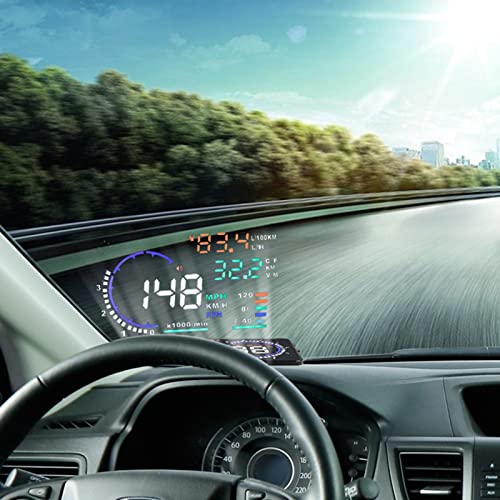
- Shows speed, RPM, temperatures, voltage, and fuel data
- Includes multiple configurable driving alarms
- Designed for OBDII/EUOBD-compatible vehicles
Best For: Vehicle owners wanting extensive dashboard information
Dual-Satellite Simplicity

- GPS and Beidou positioning
- Automatic brightness adjustment
- Three overspeed alerts and USB power
Best For: Drivers wanting a simple, adjustable speed HUD
Connected All-Vehicle Option

- CarPlay and Android Auto support
- OBD and cigarette-lighter cables
- Broad vehicle compatibility
Best For: Drivers wanting smartphone integration across many vehicle types
Alert-Focused Navigation
GPS Dual-System Driving Display

- GPS and Beidou positioning
- Overspeed and fatigue alerts
- Automatic brightness and compact design
Best For: Drivers prioritizing driving reminders and essential trip data
Best Wireless Upgrade
VIVIHUD V3-SE Wireless CarPlay HUD

- Wireless Apple CarPlay and Android Auto
- HD anti-reflection screen with automatic brightness
- Portable, plug-and-play fit for many vehicles
Best For: Drivers seeking wireless navigation and smartphone features
Best Diagnostic Flexibility

- Combines OBD2 vehicle data with GPS mode
- Scans and clears engine fault codes
- Customizable alerts for speed, temperature, voltage, and RPM
Best For: Owners of compatible vehicles wanting monitoring and diagnostics
Best Large-Screen Monitor

- Large 5.5-inch HD display with automatic brightness
- Shows GPS speed plus key engine data
- Includes alerts and basic fault-code functions
Best For: Drivers wanting highly visible speed and vehicle monitoring
Best Plug-and-Play GPS HUD – K1 USB GPS Speedometer
For drivers comparing gps car head up displays, the K1 is a straightforward USB-powered option that projects speed into your line of sight. Its GPS and BDS positioning, 10Hz refresh rate, large font, and automatic brightness adjustment make it practical for everyday driving without requiring an OBD port.
Best For: Drivers who want a simple, readable GPS speed display with broad USB compatibility.
Pros:
- Dual-mode GPS+BDS positioning with a 10Hz refresh rate
- USB 5V plug-and-play power works with most USB-equipped vehicles
- Large MPH display with automatic brightness adjustment
Cons:
- GPS speed may vary by approximately 0.6–1.8 MPH
- Satellite reception can be affected by tunnels, garages, weather, or metallic windshield film
This is a focused speedometer rather than a full vehicle-data display. Its compact design and no-OBD setup make it a convenient choice when clear speed visibility is the main priority.
Best Solar-Powered GPS HUD – Multifunction Solar Speedometer
Among gps car head up displays, this multifunction model stands out for its solar-assisted power and broader readout. It displays speed, time, temperature, altitude, and other driving information on a large LCD, while GPS positioning supports speed compensation and overspeed alerts.
Best For: Drivers who want a rechargeable HUD with extra vehicle and trip information.
Pros:
- Supports both solar charging and USB power
- Displays speed, time, temperature, altitude, and related information
- Includes adjustable overspeed alarm and fatigue-driving reminder
Cons:
- Its larger feature set may be more than needed for drivers seeking speed only
- Solar charging performance depends on available light
The combination of solar and USB charging can reduce reliance on a constant cable connection. Choose it if alerts and multiple readings are more valuable to you than a minimal display.
Best Compact GPS HUD Alternative – K1 GPS Speedometer
This K1 model is another practical entry in gps car head up displays, using GPS+BDS satellite positioning to show speed without connecting to the vehicle’s OBD system. A large, anti-reflective display and automatic brightness sensor are designed to keep the reading visible in changing light.
Best For: Drivers seeking a compact windshield speed display with quick USB setup.
Pros:
- Connects with up to 32 satellites according to the supplied specifications
- 10Hz refresh rate supports responsive speed updates
- Compact ABS housing with large, sunglasses-friendly lettering
Cons:
- GPS readings can have a stated deviation of 0.6–1.8 MPH
- Performance may be reduced in tunnels, underground garages, or heavy weather
With the same focused approach as a basic GPS speedometer, this unit avoids OBD compatibility concerns. It is best suited to buyers who prioritize easy installation and a clear speed readout.
Best OBD Vehicle-Data HUD – 5.5-Inch Multi-Color OBD HUD
Unlike GPS-only gps car head up displays, this 5.5-inch OBDII/EUOBD unit reads information from a compatible vehicle’s onboard system. It can show speed, engine speed, temperatures, voltage, fuel-consumption data, mileage, and fault codes, along with several configurable warnings.
Best For: Owners of OBDII- or EUOBD-compatible vehicles who want dashboard-style vehicle data in their sightline.
Pros:
- Displays multiple vehicle metrics, including speed, RPM, water temperature, and battery voltage
- Supports overspeed, high-temperature, low-voltage, and fatigue-driving reminders
- Offers adjustable brightness and nano-treated reflection reduction
Cons:
- Requires an OBDII or EUOBD-compatible vehicle
- It is less universally compatible than a USB-powered GPS display
This model is the stronger pick for drivers who want more than speed, provided their vehicle supports the required OBD interface. Its auto power-on and power-off behavior also suits regular commuting.
Dual-Satellite Simplicity – Automatic GPS Speed Display
For drivers comparing gps car head up displays, this plug-and-play model combines GPS and Beidou positioning with a large, windshield-facing readout. It shows speed, time, direction, distance, and satellite-clock information, while automatic brightness adjustment helps keep the display readable in changing light.
Best For: Drivers who want straightforward USB-powered speed and navigation information with flexible alerts.
Pros:
- GPS and Beidou dual-mode positioning provides stable satellite-based data.
- Automatic light sensing and the included shield help manage daytime reflections and nighttime glare.
- Offers MPH/KM/H switching, speed calibration, three overspeed alarm levels, and multiple display modes.
- Automatically powers off with the vehicle to avoid ongoing battery drain while parked.
Cons:
- Requires a 5V USB connection or cigarette-lighter-to-USB power source.
- Its functions focus on speed, time, direction, and trip information rather than phone projection.
This is a practical choice when accurate satellite speed data and easy installation matter more than advanced smartphone features. Its adjustable settings and automatic brightness make it especially convenient for regular day and night driving.
Connected All-Vehicle Option – CarPlay and Android Auto HUD
This versatile option among gps car head up displays adds CarPlay and Android Auto support alongside speedometer functionality. It is designed for broad vehicle compatibility, includes both OBD and cigarette-lighter power options, and uses a compact dashboard-mounted format for quick installation.
Best For: Drivers seeking a feature-rich HUD that can work across older, modified, new-energy, and conventional vehicles.
Pros:
- Supports CarPlay and Android Auto with Bluetooth and Wi-Fi phone connection.
- Includes both OBD and cigarette-lighter power cables for flexible installation.
- Designed for sedans, trucks, SUVs, RVs, pickup trucks, and vehicles without OBD support.
- Operates from -20°C to 75°C and includes overheat protection with automatic cooling-fan operation.
Cons:
- Phone pairing requires Bluetooth and Wi-Fi setup, which is less immediate than a basic standalone HUD.
- The OBD power mode may take 10–15 minutes to shut off after parking.
- The supplied notes do not specify the complete list of on-screen driving data or alert settings.
Choose this model if smartphone integration and wide vehicle compatibility are priorities. Its dual power options and temperature protections add flexibility, though setup is more involved than with a basic GPS-only display.
Alert-Focused Navigation – GPS Dual-System Driving Display
For buyers comparing gps car head up displays, this compact GPS-and-Beidou unit emphasizes smooth speed information and driver alerts. Its 10-frame-per-second refresh rate displays speed, time, direction, mileage, satellite count, and driving duration, while automatic brightness adapts to the surroundings.
Best For: Drivers who value overspeed and fatigue-driving reminders in a compact, easy-to-place display.
Pros:
- GPS and Beidou dual-mode positioning is designed for broad vehicle compatibility.
- Displays speed, clock, driving time, distance, satellite count, and direction.
- Provides configurable overspeed alerts from 0–250 km/h and fatigue-driving alerts from 1–8 hours.
- Automatic brightness adjustment is intended to reduce glare while maintaining visibility.
Cons:
- The supplied notes do not identify the included power cable or installation method.
- It does not list smartphone projection or connected navigation features.
- Alert settings may require adjustment to match local speed limits and driving habits.
This model stands out for its fatigue and overspeed warning functions rather than connected features. Its compact form and automatic brightness make it a sensible fit for drivers wanting essential trip data without a bulky dashboard unit.
Best Wireless Upgrade – VIVIHUD V3-SE Wireless CarPlay HUD
For drivers comparing gps car head up displays, the VIVIHUD V3-SE stands out as a wireless smartphone-focused option. It adds wireless Apple CarPlay and Android Auto, navigation access, hands-free calling, music streaming, and an HD screen without replacing the vehicle’s original display.
Best For: Drivers who want wireless smartphone connectivity and navigation in older vehicles or vehicles without factory CarPlay.
Pros:
- Supports wireless Apple CarPlay and Android Auto for maps, music, calls, messages, and voice assistants.
- Portable plug-and-play installation works across cars, SUVs, pickups, vans, and RVs.
- HD anti-reflection display, automatic brightness, adjustable viewing angle, and a non-slip base support varied driving conditions.
- Also supports screen mirroring, Bluetooth audio, and hands-free calling.
Cons:
- Its feature set depends on pairing with a compatible iPhone or Android smartphone.
- The supplied notes do not specify a built-in vehicle-data diagnostic feature set.
The VIVIHUD V3-SE is a practical choice when smartphone integration matters more than detailed engine instrumentation. Its simple installation and broad vehicle compatibility make it especially appealing as a modern connectivity upgrade.
Best Diagnostic Flexibility – MH OBD2+GPS Dual-System HUD
Among gps car head up displays, the MH Head Up Display is aimed at drivers who want both navigation-based speed information and vehicle data. Its dual OBD2/GPS modes can show metrics such as speed, RPM, water temperature, voltage, altitude, direction, and driving time, while its diagnostic functions can scan and clear fault codes.
Best For: Owners of compatible post-2008 vehicles who want a compact dashboard monitor with alerts and basic diagnostic functions.
Pros:
- Switches between OBD2 vehicle data and GPS tracking modes.
- Displays a broad range of information, including RPM, water temperature, voltage, fuel consumption, altitude, and compass direction.
- Offers fault-code scanning, real-time data streams, and acceleration and brake tests.
- Includes customizable speed, temperature, voltage, and RPM alerts with adjustable brightness and units.
Cons:
- Compatibility is restricted to OBDII/EOBD-compliant vehicles and excludes several listed brands and vehicle types.
- Diesel, hybrid, pickup, RV, and modified-computer vehicles are listed as incompatible.
- On incompatible OBD2 protocols, only the GPS functions are available.
This model offers more vehicle monitoring than a basic GPS speedometer, but compatibility should be checked carefully before purchase. For a supported vehicle, the adjustable alerts and diagnostic tools add meaningful utility.
Best Large-Screen Monitor – 5.5-Inch GPS/OBD2 Car HUD
The 5.5-inch A8 is a strong option for shoppers comparing gps car head up displays and prioritizing readable instrumentation. It combines GPS speed, OBD2 vehicle data, automatic brightness, and windshield projection in a large-format display designed to keep key information visible while driving.
Best For: Drivers who prefer a large screen with speed, engine data, alerts, and plug-and-play OBD2 installation.
Pros:
- Large 5.5-inch HD screen displays GPS speed and projects information onto the windshield.
- Shows RPM, water temperature, voltage, and fuel consumption in addition to speed.
- Provides speeding and voltage alerts plus failure detection and fault-code clearing.
- Supports OBD2/EOBD vehicles and powers on through a straightforward plug-and-play setup.
Cons:
- Its vehicle-data features require a compatible OBD2 or EOBD protocol.
- The larger display may be less discreet than compact HUD units.
- The supplied details do not identify a specific vehicle-model compatibility list.
The A8 balances visibility and information density well. Its large screen and combination of GPS and OBD2 functions suit drivers who want more than speed alone, provided their vehicle supports the required protocol.
How We Picked the Best Gps Car Head Up Displays
We focused on displays that provide useful driving information through GPS, OBD2, or both. Selection criteria included speed accuracy, readability, installation method, screen visibility, alert features, compatibility, and the range of information shown. We also considered whether each unit is better suited to occasional use, daily commuting, or drivers who want a more complete secondary dashboard.
GPS-only models are generally simpler and more portable, while OBD2 units can access vehicle data such as engine speed, coolant temperature, voltage, and fault information. Dual-system models may offer broader functionality, but they can require more setup and vehicle compatibility checks.
Quick Comparison
| Best For | Look For | Typical Advantage |
|---|---|---|
| Basic speed visibility | GPS speedometer and overspeed alarm | Simple setup and broad compatibility |
| Large, easy-to-read information | 5.5-inch screen and adjustable brightness | Better visibility at a glance |
| Vehicle diagnostics | OBD2 or OBD2/GPS dual system | More engine and electrical data |
| Connected infotainment | CarPlay or Android Auto support | Navigation and media integration |
Key Buying Factors for GPS Car Head-Up Displays
Display Clarity and Placement
Choose a screen large enough to read quickly without blocking the road. Brightness adjustment, color contrast, and a suitable windshield projection angle matter in both daylight and nighttime driving. A unit that reflects poorly or sits too low can be distracting rather than helpful.
GPS, OBD2, or Dual-System Operation
GPS models usually work across more vehicles because they do not depend on a diagnostic port. OBD2 models can provide richer vehicle data, but compatibility varies by vehicle age, port location, and supported protocols. Dual-system products offer flexibility when their configuration is supported.
Information and Alerts
Confirm which data you actually need. Common options include speed, direction, mileage, time, altitude, temperature, tachometer readings, voltage, and overspeed warnings. Too many metrics can make a display harder to scan, so prioritize a clean layout.
Power and Installation
Check whether the display uses a USB cable, vehicle accessory socket, OBD2 connection, or solar-assisted power. Cable routing, adhesive mounting, and windshield positioning affect both appearance and safety. Follow local laws regarding windshield-mounted devices.
Who Should Buy Which Gps Car Head Up Displays?
Choose a compact GPS speedometer if you want an affordable, broadly compatible way to monitor speed. A larger 5.5-inch projector makes more sense for drivers who value readability and prominent alerts. Select an OBD2 model if you want engine or electrical information in addition to speed. For a more integrated experience, a CarPlay- or Android Auto-compatible HUD can combine navigation and smartphone functions with a dashboard-style display.
Before buying, verify the included accessories, measurement units, supported vehicle protocols, and return policy. The best option is not necessarily the one with the most readings; it is the one that presents the information you need clearly, reliably, and with minimal distraction.