A dual-mode car head-up display can put important driving information—such as speed, direction, engine data, and alerts—closer to your line of sight. The models in this roundup combine OBD2 and GPS functionality in different ways, making it easier to find a display that fits your vehicle and driving habits.
Before buying, check compatibility, screen readability, installation requirements, and which measurements you actually need. The guide below highlights the practical differences between these displays so you can choose with confidence.
Best 10 Dual Mode Car Head Up Displays Picks for 2026
Most Feature-Packed

- Shows speed, RPM, temperature, voltage, and more in OBD2 mode
- Offers gesture control, alerts, themes, and RGB lighting
- Includes acceleration and braking performance tests
Best For: Drivers wanting extensive vehicle data and customization
Best Simple GPS Pick
M1 White Windshield Projection HUD

- Projects speed and direction in a clean, minimal layout
- Provides overspeed and fatigue-driving alarms
- Automatically adjusts brightness for ambient light
Best For: Drivers seeking a simple GPS speed display
Best Basic OBD Display

- Shows speed, RPM, temperature, and battery voltage
- Supports metric/imperial and Celsius/Fahrenheit units
- Uses automatic vehicle-start power and shutdown
Best For: Drivers wanting essential OBD gauges and simple setup
Best for Diagnostics

- Reads and clears engine fault codes
- Displays extensive live OBD2 and GPS data
- Provides adjustable speed, temperature, voltage, and RPM alerts
Best For: Compatible-car owners wanting diagnostics and live gauges
Best Dual-System Value

- OBD and GPS operating modes
- Speed, voltage, temperature, and distance readings
- Automatic brightness with multiple alarms
Best For: Drivers seeking flexible dual-mode operation
Best OBD Data Range
- Broad vehicle-data display
- Multiple overspeed and vehicle alerts
- Manual and automatic brightness control
Best For: OBD II/EUOBD drivers wanting detailed readouts
Best Dual-Mode Data Flexibility
- OBD2 plus GPS fallback
- 10 interfaces and over 100 OBD data types
- Dashboard or windshield installation
Best For: Drivers prioritizing data variety and flexible mounting
Versatile GPS Pick

- GPS+BDS positioning with 10Hz refresh
- Shows speed plus multiple vehicle metrics
- USB plug-and-play compatibility for many vehicles
Best For: Drivers wanting extensive readouts and broad vehicle compatibility
Large-Display Choice

- Large MPH display with anti-reflective shading
- 10Hz GPS+BDS positioning
- USB-powered with automatic brightness
Best For: Drivers seeking a simple, readable speed-only HUD
Compact HUD Option

- Compact 2.76-inch-wide housing
- GPS+BDS with 10Hz refresh
- Automatic brightness and USB setup
Best For: Drivers wanting a lightweight HUD for limited dashboard space
Most Feature-Packed – OBD2+GPS Dual-Mode Car HUD
For drivers comparing dual mode car head up displays, this OBD2+GPS model stands out for its broad data coverage and customization. In OBD2/EOBD mode, it can show speed, RPM, coolant temperature, voltage, fuel consumption, compass, turbo pressure, and altitude, while GPS mode provides an alternative connection method.
Best For: Tech-focused drivers who want extensive vehicle data, configurable alerts, gesture control, and performance testing.
Pros:
- Displays a wide range of driving and engine information in OBD2/EOBD mode.
- Offers overspeed, overheat, voltage, and fatigue-driving alerts.
- Includes 13 UI themes, gesture-based page switching, RGB lighting, and acceleration/braking tests.
- Rotatable bracket and included accessories support plug-and-play installation.
Cons:
- Full data display is available only in OBD2/EOBD mode.
- The feature-rich interface may be more than needed for drivers seeking a simple speed display.
With its dual-chip design, broad customization, and performance-focused tools, this is a strong choice for buyers who want more than basic windshield speed projection.
Best Simple GPS Pick – M1 White Windshield Projection HUD
This GPS-based option takes a deliberately minimal approach to dual mode car head up displays. It projects speed and travel direction onto the windshield, adds overspeed and fatigue-driving alarms, and uses automatic brightness adjustment to keep the display readable in changing light.
Best For: Drivers who want a straightforward, low-distraction GPS speedometer for use in virtually any vehicle.
Pros:
- Simple windshield display focuses on speed and direction without excessive information.
- Supports both MPH and KM/H units and includes overspeed and fatigue warnings.
- Automatic brightness adjusts for daytime and nighttime conditions.
- USB plug-and-play setup includes a reflective film and anti-slip mat.
Cons:
- Requires satellite acquisition before speed appears.
- GPS searching can be slowed by garages, dense buildings, metal window film, or another nearby GPS device.
- Displays less vehicle information than OBD2-based alternatives.
The M1 is best suited to buyers who value a clean, glanceable speed display over engine gauges and diagnostic information.
Best Basic OBD Display – Dual-Mode Car Multi-Mode HUD
This dual mode car head up display is a practical OBD II/EUOBD gauge for compatible vehicles. Its 3-inch high-definition screen can show speed, engine RPM, water temperature, battery voltage, and several warning indicators, with automatic power control when the vehicle starts or shuts down.
Best For: Drivers seeking an affordable-style, plug-and-play OBD gauge with essential engine readings and alarms.
Pros:
- Automatically adapts to vehicles using OBD II or EUOBD systems.
- Displays speed, RPM, water temperature, voltage, and warning information.
- Supports kilometer/mile and Celsius/Fahrenheit switching.
- Automatic power-on and shutdown help protect the vehicle battery.
Cons:
- Compatibility depends on an OBD II or EUOBD-equipped vehicle.
- Provides fewer features and customization options than more advanced dual-system models.
For buyers who mainly want readable essential gauges and straightforward installation, this model offers a simple alternative to more elaborate HUD systems.
Best for Diagnostics – OBD2+GPS Gauge Display
Among dual mode car head up displays, this model is especially useful for drivers who want diagnostic capability alongside a GPS fallback. It can read and clear engine fault codes, display live data through OBD2, and switch to GPS functions when the vehicle cannot provide full OBD2 information.
Best For: OBD2-compatible vehicle owners who want live gauges, fault-code functions, and adjustable safety alerts.
Pros:
- Reads and clears engine fault codes and displays real-time data streams.
- Shows speed, tachometer, fuel consumption, temperature, voltage, altitude, turbo pressure, and more.
- Switches between OBD2 diagnostic mode and GPS mode.
- Offers configurable speed, temperature, voltage, and RPM alarms plus multiple display interfaces.
Cons:
- Full OBD2 compatibility is limited to qualifying OBDII/EOBD vehicles produced after 2008.
- Listed incompatible vehicles include several brands and vehicle types such as hybrids, diesel vehicles, RVs, and pickups.
- On incompatible OBD2 protocols, only GPS functions are available.
This is a capable choice for buyers who prioritize vehicle diagnostics and live data, provided their car meets the stated compatibility requirements.
Best Dual-System Value – M7 OBD/GPS Car HUD
This M7 is a practical choice for drivers comparing dual mode car head up displays. It supports OBD and GPS operation, projects key information such as speed and voltage, and offers automatic brightness adjustment. Installation is plug-and-play, but compatibility details matter before choosing OBD mode.
Best For: Drivers who want one compact HUD with both OBD and GPS modes, especially when vehicle compatibility is uncertain.
Pros:
- Offers both OBD and GPS modes.
- Displays speed, voltage, water temperature, and driving distance.
- Includes adjustable speed, temperature, and voltage alarms.
- Automatically adjusts brightness to the surrounding environment.
Cons:
- OBD II mode is listed for vehicles manufactured after 2008.
- OBD mode is not compatible with electric, diesel, pickup, RV, or computer-modified vehicles according to the supplied notes.
The M7 stands out for broad operating flexibility and a simple installation. Use GPS mode when the vehicle does not support OBD II, while noting that GPS mode provides fewer vehicle-data readings.
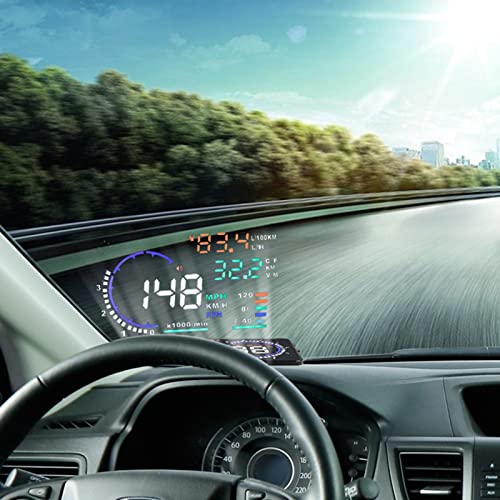
Best OBD Data Range – 5.5-Inch Multi-Color HUD
This 5.5-inch HUD is aimed at drivers who want a broad dashboard-data display in an OBD II or EUOBD vehicle. As one of the larger dual mode car head up displays options in this roundup, it shows speed, engine speed, temperatures, voltage, fuel-use information, mileage, and fault codes, with configurable brightness and warning functions.
Best For: OBD II or EUOBD vehicle owners who want extensive vehicle information and multiple driving alerts.
Pros:
- Displays speed, engine speed, water temperature, voltage, fuel consumption, mileage, and fault codes.
- Supports manual brightness adjustment and automatic brightness optimization.
- Provides overspeed, high-temperature, low-voltage, fatigue, and shift reminders.
- Automatically powers on with the vehicle and stops when the vehicle is powered off.
Cons:
- Designed for vehicles with OBD II or EUOBD systems.
- The supplied notes do not describe a GPS fallback mode.
This model is compelling for information-heavy OBD installations. Its larger screen and warning features may appeal to drivers who prioritize readable data and reminders over universal vehicle compatibility.
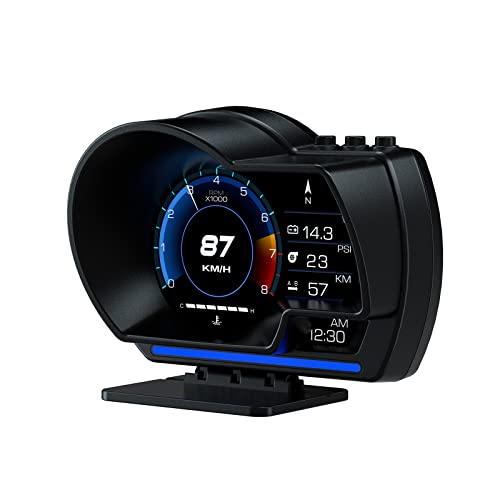
Best Dual-Mode Data Flexibility – P6 OBD2/GPS HUD
The P6 is built for shoppers who want a dual-mode display with richer OBD information and a GPS fallback. It combines OBD2 and GPS functionality, offers 10 switchable interfaces, and can be mounted on the dashboard or windshield. That makes it a strong contender among dual mode car head up displays for drivers comparing data depth and installation flexibility.
Best For: Drivers who want abundant OBD data, a GPS fallback, and multiple mounting options.
Pros:
- Combines OBD2 and GPS functions in one unit.
- Offers 10 switchable interfaces and can read more than 100 kinds of vehicle data through OBD.
- Displays speed, voltage, fuel consumption, RPM, and water temperature.
- Includes overspeed color alerts and dashboard or windshield installation options.
Cons:
- Vehicles without the OBD2 protocol display GPS functions only.
- The supplied notes do not specify the full vehicle-compatibility range for OBD2 mode.
The P6 is the data-focused pick in this group, particularly for compatible vehicles. Its GPS fallback and two mounting methods add versatility, while the OBD2 mode is where its broadest feature set is available.
Versatile GPS Pick – W2 Universal Digital HUD
For shoppers comparing dual mode car head up displays, the W2 stands out for its broad vehicle compatibility and expanded driving information. Its GPS+BDS positioning chip, 10Hz refresh rate, and USB plug-and-play setup make it a flexible choice for vehicles with an available USB port.
Best For: Drivers who want more than speed, including RPM, travel time, fuel consumption, voltage, and direction information.
Pros:
- GPS+BDS dual-mode positioning can connect with up to 32 satellites.
- Displays multiple driving metrics and includes an overspeed alarm.
- Works with a wide range of USB-equipped vehicles, including cars, trucks, motorcycles, boats, and golf carts.
- Automatic brightness adjustment supports visibility in daytime and nighttime conditions.
Cons:
- GPS performance and data stability depend on signal strength and are best in open areas.
- The device is larger than some compact HUD alternatives, measuring 4.92 by 3.34 by 1.73 inches.
The W2 is the more feature-rich option in this group. Choose it if you value broad compatibility and extra vehicle data, while keeping in mind that GPS-based information can be affected by the surrounding environment.
Large-Display Choice – K1 GPS Car HUD
This K1 is a straightforward option among dual mode car head up displays, focusing on clear MPH speed visibility. Dual-mode GPS+BDS positioning, a 10Hz refresh rate, automatic brightness, and USB power provide the core features needed for an easy-to-use speed display.
Best For: Drivers who prioritize a large, easy-to-read MPH display and simple USB installation.
Pros:
- Uses GPS+BDS positioning with support for up to 32 satellites and 10Hz refresh.
- Large font and anti-reflective metal shading improve readability.
- Automatic brightness adjustment helps limit glare at night.
- USB-powered and compatible with most USB-equipped cars, trucks, and motorcycles.
Cons:
- GPS speed can have a stated deviation of about 0.6–1.8 MPH.
- Satellite reception may be affected by tunnels, garages, severe weather, or metallic windshield film.
- The supplied information focuses on speed display rather than a broader set of vehicle metrics.
The K1 is a practical pick for drivers who want a readable speed display without an OBD connection. Its simple design is convenient, but like other GPS HUDs, it performs best with a clear satellite signal.
Compact HUD Option – K1 White GPS Speedometer
For buyers seeking dual mode car head up displays in a smaller housing, this K1 White model offers the same core GPS+BDS functionality in a compact 2.76 by 1.69 by 0.79-inch design. It provides 10Hz speed updates, USB plug-and-play power, and automatic brightness adjustment.
Best For: Drivers who want a lightweight, compact HUD for clear MPH readings in a smaller dashboard footprint.
Pros:
- Compact dimensions and a 1.6-ounce weight make it easy to place on the dashboard.
- Dual-mode GPS+BDS positioning supports up to 32 satellites and 10Hz refresh.
- Large font, anti-reflective shading, and automatic brightness support readability.
- USB 5V plug-and-play setup works with most compatible cars, trucks, and motorcycles.
Cons:
- GPS readings may vary by approximately 0.6–1.8 MPH.
- Signal quality can be reduced in tunnels, underground garages, heavy rain or fog, and behind metallic windshield film.
- The supplied features center on speed rather than additional vehicle information.
This compact K1 is a sensible choice when dashboard space matters. It delivers the essential GPS speed-display features in a small package, provided the vehicle has a clear enough satellite signal.
How We Picked the Best Dual Mode Car Head Up Displays
We focused on displays that support two operating methods or data sources, typically OBD2 and GPS. That matters because OBD2 can provide vehicle-specific information such as engine speed, coolant temperature, voltage, and fault alerts, while GPS-based units can work in more vehicles and generally provide speed and direction without accessing the car’s diagnostic system.
We also considered installation style, plug-and-play operation, windshield projection, speed-unit options, overspeed warnings, visibility, and the range of information each display claims to show. Since compatibility varies by vehicle, buyers should confirm connector type, supported protocols, and model-year requirements before ordering.
Quick Comparison
| Feature | Why It Matters |
|---|---|
| OBD2 connection | Enables vehicle-specific data and often provides faster, more detailed readings. |
| GPS mode | Offers broader compatibility and can work when OBD2 support is unavailable. |
| Windshield projection | Keeps speed and alerts visible without looking down at the instrument cluster. |
| Multiple measurements | Useful for drivers who want RPM, temperature, voltage, or fault information. |
| Overspeed alerts | Provides a visual or audible reminder when a selected speed is exceeded. |
Key Buying Factors for Dual-Mode Car Head-Up Displays
Compatibility and Connection
Confirm whether your vehicle has a compatible OBD2 or EOBD port and whether the display supports your vehicle’s communication protocol. GPS models are usually the safer choice for older, imported, or uncertain-fit vehicles, though GPS readings may respond differently from the car’s speedometer.
Information Displayed
Some units are primarily digital speedometers, while others add RPM, coolant temperature, battery voltage, fuel-related information, or diagnostic alerts. Choose only the measurements you will use; a less crowded screen may be easier to read while driving.
Visibility and Setup
Look for adjustable brightness, clear numerals, selectable km/h and MPH units, and a projection position that does not block your view. A USB-powered, plug-and-play design can simplify installation, but cable routing and dashboard placement still affect the finished setup.
Alerts and Accuracy
Overspeed and fatigue-driving alerts can be useful reminders, but they should supplement attentive driving rather than replace it. GPS accuracy can vary in tunnels, dense urban areas, or locations with weak satellite reception.
Who Should Buy Which Dual Mode Car Head Up Displays?
Choose an OBD2-plus-GPS model if you want both broad fallback compatibility and deeper vehicle information. A GPS-only windshield display is a practical choice for straightforward speed and direction readings, especially in vehicles where OBD2 support is uncertain. Drivers who want engine monitoring should prioritize models listing tachometer, coolant-temperature, voltage, and fault-display functions. If simplicity is the main goal, select a compact plug-and-play unit with a bright, uncluttered speed readout and adjustable alerts.