The best slow-speed bench grinders give you more control during sharpening and reduce the risk of overheating delicate tool edges. They are especially useful for woodworking tools, knives, turning tools, and general workshop maintenance.
This roundup compares 10 options across dedicated low-speed models, conventional bench grinders, wet sharpening systems, and versatile combination machines. Use the buying guide below to match motor power, wheel size, speed, cooling, and accessories to your work.
Best 10 Slow Speed Bench Grinders Picks for 2026
Precision Pick
WEN BG4286 Slow-Speed Grinder with Stand

- 1,750-RPM soft-start motor for controlled sharpening
- Includes 60- and 120-grit wheels
- Stand includes water pot and steel construction
Best For: Tool sharpening with an elevated, stable setup
Power Workshop Pick
DEWALT DW758 8-Inch Bench Grinder

- 3/4-HP induction motor for powerful grinding
- 3,600 RPM favors fast material removal
- Wide 12-1/2-inch wheel spacing for larger workpieces
Best For: Heavy-duty, high-speed shop grinding
Custom Setup Pick
RIKON 80-808M Low-Speed Grinder

- 1-HP induction motor runs at 1,750 RPM
- Cast-iron base has anti-vibration feet
- Ships without wheels for user-selected customization
Best For: Custom sharpening stations and woodworking setups
Cooling Convenience Pick
SKIL BI9502-00 8-Inch Bench Grinder

- 3.0-amp motor runs at 3,450 RPM
- Built-in water tray and LED work light
- Includes medium and coarse grinding wheels
Best For: General grinding with convenient cooling and lighting
Industrial Power Pick
JET 8-Inch Industrial Bench Grinder

- 1 HP, 3,600 RPM motor
- Cast iron construction and pre-drilled base
- Includes 36- and 60-grit wheels
Best For: Frequent general-purpose grinding in demanding workshops
True Slow-Speed Sharpening Pick
10-Inch Wet/Dry Sharpening System

- Variable speed from 90–160 RPM
- Water-cooled grinding wheel limits heat
- Includes leather strop and angle guide
Best For: Controlled sharpening of knives and woodworking tools
Compact Shop Pick
Metabo DS 150 M 6-Inch Bench Grinder

- 370-watt low-noise, low-vibration motor
- Includes 36 P and 60 N grinding wheels
- Adjustable shields, rests, and rubber feet
Best For: Routine grinding in compact, quieter workshops
Best All-Around Grinder
WEN BG4282 8-Inch Bench Grinder
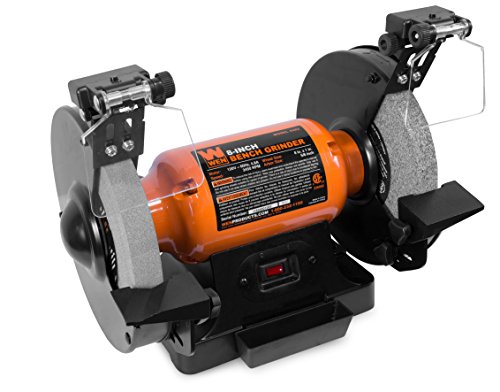
- 4.8-amp motor reaches up to 3,450 RPM
- LED eye guards and onboard quenching tray
- Includes 36- and 60-grit wheels
Best For: General-purpose sharpening and tool restoration
Best Heavy-Duty Build
Metabo DS 200 Plus 8-Inch Bench Grinder

- 5.5-amp, 600-watt induction motor
- Low-noise, low-vibration design with rubber feet
- Includes LED lighting, steady rests, and two wheels
Best For: Demanding metalworking and stable shop use
Best Combo Design
VEVOR 8-Inch Grinder and Belt Sander
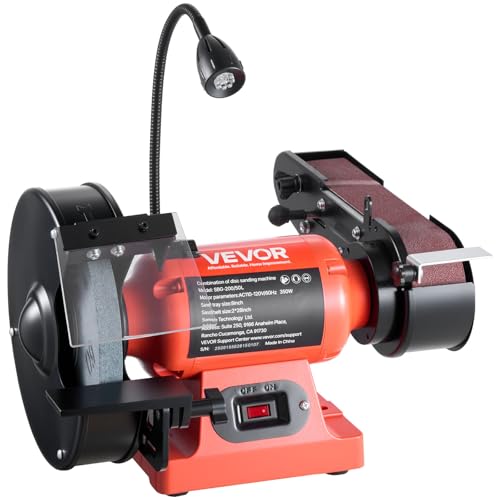
- Combines an 8-inch grinder with a 2-by-28-inch belt sander
- Belt arm adjusts from 0 to 90 degrees
- Includes LED light, eye shield, and rubber feet
Best For: DIY grinding, knife sharpening, and belt sanding
Precision Pick – WEN BG4286 Slow-Speed Grinder with Stand
For sharpening and restoring tools, the WEN BG4286 is a practical choice among slow speed bench grinders. Its 1,750-RPM motor is designed to provide more control and reduce heat, while the included stand adds a dedicated, elevated workstation.
Best For: Sharpening knives, chisels, bits, and other tools where controlled grinding matters.
Pros:
- 1,750-RPM soft-start motor helps limit heat buildup.
- Includes 60-grit and 120-grit wheels for general and fine finishing work.
- Pivoting tool rests, adjustable eye guards, and pre-drilled mounting holes support setup flexibility.
- Included cast-iron and steel stand has an onboard water pot for cooling projects.
Cons:
- The stand increases the overall footprint compared with a grinder alone.
- The included wheel selection may not suit every specialized sharpening task.
This package is a strong fit when you want a low-speed grinder plus a stable pedestal in one purchase. The water pot and dual wheels make it especially versatile for routine workshop sharpening.
Power Workshop Pick – DEWALT DW758 8-Inch Bench Grinder
The DEWALT DW758 is a high-powered bench grinder rather than a true low-speed model. Its 3,600-RPM motor is better suited to fast material removal, making it worth considering alongside slow speed bench grinders when productivity is more important than heat control.
Best For: High-speed grinding and larger workpieces in demanding shop applications.
Pros:
- 3/4-HP induction motor provides substantial grinding power.
- Cast-iron base and motor housing are built for durability.
- 12-1/2-inch spacing between wheels accommodates longer and larger workpieces.
- Includes 36-grit and 60-grit wheels, tool rests, eye shields, and spark deflectors.
Cons:
- Its 3,600-RPM speed is not ideal for low-heat precision sharpening.
- It lacks the water-cooling features included with some slower models.
Choose this DEWALT when rapid stock removal and rugged construction take priority. For delicate edge work, its higher speed calls for more careful technique than a dedicated slow-speed grinder.
Custom Setup Pick – RIKON 80-808M Low-Speed Grinder
The RIKON 80-808M gives shoppers a flexible option among slow speed bench grinders by leaving the wheel selection open. Its 1-HP, 1,750-RPM induction motor and stable cast-iron base suit users who want to configure the grinder around particular sharpening materials and grits.
Best For: Woodworkers and sharpeners building a customized wheel setup.
Pros:
- Quiet 1-HP induction motor runs at a controlled 1,750 RPM.
- Cast-iron base and rubber anti-vibration feet help reduce movement.
- Built-in flexible LED light improves visibility at the work area.
- Safety switch with lockout key and 5/8-inch threaded arbor add useful setup features.
Cons:
- Grinding wheels are not included, so additional selection and purchase are required.
- The open wheel configuration may require more setup knowledge than a ready-to-use kit.
This is a good match for experienced users who already know which wheels they need. Its low speed, higher motor rating, lighting, and stable base provide a solid foundation for a tailored sharpening station.
Cooling Convenience Pick – SKIL BI9502-00 8-Inch Bench Grinder
SKIL 3.0 Amp 8 In. Bench Grinder with Built-in Water Cooling Tray & LED Work Light - BI9502-00
Check Price On AmazonThe SKIL BI9502-00 is a feature-rich alternative to slow speed bench grinders, with a 3,450-RPM motor for continuous grinding and a built-in water tray for cooling. It is best considered when convenience, visibility, and general-purpose grinding matter more than dedicated low-speed operation.
Best For: General workshop grinding with integrated cooling and lighting.
Pros:
- 3.0-amp motor provides continuous speed for consistent grinding.
- Built-in water cooling tray helps cool the workpiece.
- LED work light and magnified eye shields improve visibility and protection.
- Adjustable V-grooved tool rests and pre-drilled base support accurate setup.
Cons:
- Its 3,450-RPM speed is considerably faster than dedicated low-speed models.
- The supplied medium and coarse wheels may be less suitable for fine sharpening.
The SKIL offers useful built-in accessories for everyday grinding, especially where cooling and workpiece visibility are priorities. However, users specifically seeking low-heat edge sharpening should favor a 1,750-RPM model instead.
Industrial Power Pick – JET 8-Inch Industrial Bench Grinder
For demanding shop work, the JET IBG-8 is a heavy-duty option among slow speed bench grinders, though its 3,600 RPM motor is designed more for fast material removal than low-speed sharpening. Its cast iron construction, 1 HP motor, and included coarse and fine vitrified wheels make it well suited to general grinding tasks.
Best For: Workshops needing a sturdy, high-power grinder for frequent general-purpose grinding.
Pros:
- 1 HP motor delivers substantial grinding power.
- Cast iron construction is suited to demanding environments.
- Includes 36-grit and 60-grit vitrified wheels.
- Pre-drilled base, adjustable rests, and safety shields support secure operation.
Cons:
- Runs at 3,600 RPM, so it is not a true low-speed sharpening grinder.
- At 44 pounds, it is less convenient to move.
The JET is the strongest choice here for robust bench grinding, but shoppers specifically seeking slow speed bench grinders should consider its higher operating speed before buying.
True Slow-Speed Sharpening Pick – 10-Inch Wet/Dry Sharpening System
This 10-inch wet/dry system is the clearest match for slow speed bench grinders because its variable-speed motor runs from 90 to 160 RPM. Water cooling helps control heat while sharpening, and the included leather strop, angle guide, and adjustable jig support make it geared toward precise tool maintenance.
Best For: Sharpening knives, chisels, scissors, lathe tools, and carving tools with controlled, low-speed operation.
Pros:
- Very low variable speed of 90–160 RPM.
- Water-cooled 10-inch aluminum oxide wheel helps reduce overheating.
- Leather strop wheel removes burrs and refines edges.
- Angle guide and adjustable jig support promote consistent sharpening.
Cons:
- Designed for sharpening rather than fast stock removal.
- The leather wheel must be used in the correct direction to avoid cutting into the leather.
- Its 15.58 kg weight makes it less portable.
For buyers prioritizing slow speed bench grinders for edge work, this system offers the most specialized setup in the group, with wet cooling and honing features that support careful sharpening.
Compact Shop Pick – Metabo DS 150 M 6-Inch Bench Grinder
The Metabo DS 150 M is a compact bench grinder with a 370-watt, low-noise, low-vibration induction motor. It operates at 3,600 RPM rather than the low speeds associated with dedicated slow speed bench grinders, but adjustable eye protection, steady rests, rubber feet, and two included wheels make it practical for routine shop grinding.
Best For: Compact workshops needing a relatively quiet grinder for everyday grinding and deburring.
Pros:
- Maintenance-free induction motor is designed for low noise and vibration.
- Includes 36 P and 60 N vitrified aluminum oxide wheels.
- Adjustable eye shield, spark deflectors, and steady rests improve usability.
- Vibration-dampening rubber feet support stable placement.
Cons:
- Its 3,600 RPM speed is not intended for slow-speed sharpening.
- Lower 370-watt output offers less power than the 1 HP JET.
The Metabo is a sensible space-conscious shop option, especially when low vibration matters, but it is better categorized as a standard-speed grinder than one of the slow speed bench grinders.
Best All-Around Grinder – WEN BG4282 8-Inch Bench Grinder
For shoppers comparing slow speed bench grinders, the WEN BG4282 offers an 8-inch setup with useful visibility and cooling features. Its 4.8-amp motor reaches up to 3,450 RPM and drives included 36- and 60-grit wheels for tool, knife, and bit maintenance.
Best For: General-purpose sharpening, grinding, and tool restoration in a home workshop.
Pros:
- Includes both 36-grit and 60-grit grinding wheels.
- Adjustable eye guards have built-in LED work lights.
- Onboard quenching tray helps cool workpieces during extended sessions.
- Includes pivoting tool rests and a two-year warranty.
Cons:
- Its single-speed motor reaches up to 3,450 RPM rather than offering variable speed.
- At 30.5 pounds, it is substantial for a compact bench tool.
The WEN is a practical choice when you want a conventional bench grinder with solid included accessories, integrated lighting, and a cooling tray. It is best suited to buyers who value versatility and convenience over true low-speed operation.
Best Heavy-Duty Build – Metabo DS 200 Plus 8-Inch Bench Grinder
Among slow speed bench grinders, the Metabo DS 200 Plus emphasizes a heavy-duty, steady work platform rather than reduced rotational speed. Its 5.5-amp, 600-watt induction motor runs at 3,600 RPM and includes vibration-control features for demanding shop use.
Best For: Metalworking and workshop users who want a robust, low-noise bench grinder with substantial stability features.
Pros:
- Maintenance-free induction motor is designed for low-noise, low-vibration operation.
- Heavy-duty adjustable steady rests support controlled work.
- Vibration-dampening rubber feet improve stability.
- Includes LED work lights, adjustable eye shields, spark deflectors, and two grinding wheels.
Cons:
- Its 3,600 RPM maximum is not a slow-speed setting.
- The supplied motor is intended for 120V single-phase corded operation.
The Metabo stands out for its durable shop-oriented design and stability-focused features. Choose it when low vibration, steady rests, and heavy-duty construction matter more than running at a slower grinding speed.
Best Combo Design – VEVOR 8-Inch Grinder and Belt Sander
For buyers considering slow speed bench grinders with added functionality, the VEVOR combines an 8-inch grinder with a 2-by-28-inch belt sander. The grinder runs at 3,450 RPM while the sanding belt runs at 1,500 RPM, giving you separate speeds for grinding and sanding tasks.
Best For: DIY users who need one machine for metal grinding, knife sharpening, woodworking, and belt sanding.
Pros:
- Combines a grinding wheel and belt sander in one machine.
- Belt arm adjusts from 0 to 90 degrees for horizontal or vertical sanding.
- Built-in LED light and transparent eye shield improve visibility and protection.
- Steel body and non-slip rubber feet help limit wobbling and vibration.
Cons:
- The grinding wheel still operates at up to 3,450 RPM, so it is not a low-speed grinder.
- The 350-watt motor is less powerful on paper than the other listed models.
- Its combo design may occupy more workspace than a grinder alone.
The VEVOR is the most versatile option in this group, especially if sanding is as important as grinding. Its dedicated 1,500 RPM belt speed adds useful control for finishing, while the grinder handles faster material removal.
How We Picked the Best Slow Speed Bench Grinders
We evaluated these Slow Speed Bench Grinders and related sharpening machines by looking at the features that matter most in real workshops: operating speed, motor output, wheel size, construction, cooling options, work-light visibility, eye protection, adjustability, and expected use. Dedicated low-speed models received particular attention because slower wheels provide better control and can help limit heat buildup while sharpening.
The selection also includes standard high-speed bench grinders for users who need faster material removal, wet systems for edge-sensitive tools, and a grinder-sander combination for broader workshop flexibility. Because no single machine suits every job, the recommendations cover compact home-shop tools through heavier-duty industrial designs.
Quick Comparison
| Best For | Look For | Featured Type |
|---|---|---|
| Controlled tool sharpening | Lower RPM and suitable wheels | Dedicated slow-speed grinder |
| General metal removal | Higher horsepower and rigid base | Standard bench grinder |
| Heat-sensitive edges | Water cooling and adjustable speed | Wet sharpening system |
| Small workshops | Compact footprint and built-in light | 6- or 8-inch bench grinder |
| Multi-purpose sanding | Belt attachment and stable platform | Grinder-sander combination |
Key Buying Factors for Slow-Speed Bench Grinders
Speed and Sharpening Control
Lower RPM is valuable when sharpening chisels, plane irons, turning tools, and knives because it gives you more time to control the edge and can reduce overheating. Conventional 3,000- to 3,600-RPM grinders are better suited to quick stock removal, deburring, and heavier grinding. Variable-speed and wet systems offer the most control, but they may require more setup and maintenance.
Motor Power and Wheel Size
Higher amperage or horsepower helps a grinder maintain speed under load, but it usually comes with greater size, noise, and cost. An 8-inch wheel offers a useful balance for many home workshops. Six-inch models take up less space, while 10-inch wet systems can provide a larger sharpening surface and smoother support for long tools.
Cooling, Wheels, and Accessories
A water tray or wet wheel is helpful for tools that are easily damaged by heat. Check whether the included wheels match your work and whether replacement wheels are readily available. Tool rests should adjust securely, and spark deflectors, eye shields, work lights, and a stable cast-iron base improve everyday usability and safety.
Workspace and Electrical Requirements
Measure your bench before buying, allowing room for wheel changes and safe handling. Confirm the voltage and outlet requirements, especially for industrial 1-horsepower models. A grinder that can be firmly bolted down is generally safer and more comfortable than one that shifts during use.
Who Should Buy Which Slow Speed Bench Grinders?
Choose a Dedicated Slow-Speed Model for Sharpening
Woodworkers, knife makers, turners, and anyone who regularly sharpens tools should prioritize a purpose-built low-speed grinder or wet sharpening system. These designs emphasize control and cooler operation rather than maximum material removal.
Choose a Standard High-Speed Grinder for Fabrication
DIYers, welders, and metalworkers who mainly deburr, clean, shape, or remove material will usually get better productivity from a conventional 6- or 8-inch grinder with a stronger motor and rigid base.
Choose a Compact or Combination Model for Versatility
Limited-space users should consider a compact grinder with integrated lighting and cooling features. If sanding is also part of the workload, a grinder-and-belt-sander combination can provide more capability without requiring another machine.
Before ordering, verify the included accessories, wheel specifications, warranty, and replacement-parts availability. The best choice is the machine that matches your usual tasks, not necessarily the fastest or most powerful option.