Choosing the right battery tester can save time, prevent guesswork, and help you spot charging problems before they leave you stranded.
Below, we’ve rounded up the best options for home garage use, from simple voltage checkers to more advanced load testers and system analyzers.
Best 10 Car Battery Testers for Home Mechanics Picks for 2026
Project-Farm-Noted Pick
ANCEL BA101 12V Battery and Alternator Analyzer

- Reads SOH, SOC, voltage, current, and CCA.
- Runs cranking and charging-system tests.
- Supports many 12V battery standards and types.
Best For: Home mechanics who want an easy-to-read 12V tester with broad coverage.
Heavy-Duty Load Tester
Schumacher BT-100 6V/12V Battery Load Tester

- Tests battery, charging system, and starter motor.
- Supports 6V and 12V batteries up to 1000 CCA.
- Built with a steel case and heavy-duty clamps.
Best For: DIYers who want a rugged load tester with full basic diagnostics.
Compact Plug-and-Test Option
MOTOPOWER MP0514A 12V Digital Tester
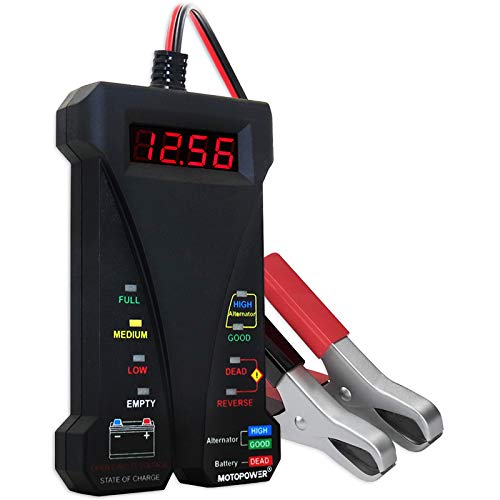
- Plug-and-test setup with simple operation.
- LCD plus LED indicators for clear readings.
- Includes reverse and over-voltage protection.
Best For: Drivers and DIYers who want a compact, simple voltage checker.
Versatile Load Tester
QWORK 12V 100A Battery and Voltage Tester

- Checks 6V and 12V batteries up to 1,000 CCA.
- Adds alternator testing for basic diagnostics.
- Uses a shock-resistant steel case with copper-plated clamps.
Best For: Garage users who want a compact load tester with alternator checks.
Simple 12V Reader
MOTOPOWER MP0515A Battery Tester

- Tests 12V batteries from 100-2000 CCA
- Checks cranking and charging systems
- Compact with storage bag and 2-year warranty
Best For: Home mechanics needing a simple 12V battery and charging tester
All-Around Value Scanner

- Supports 12V batteries from 100-2000 CCA
- Tests battery health, cranking, charging, alternator, and starter
- Plug-and-play for in-vehicle or out-of-vehicle testing
Best For: DIY users wanting a budget-friendly all-in-one 12V analyzer
Heavy-Duty Dual-System Tester

- Supports 12V/24V lead-acid and lithium batteries
- Reports SOC, SOH, voltage, and internal resistance
- Includes cranking/charging tests and safety protection
Best For: Home mechanics needing broader vehicle and battery compatibility
Multi-Voltage Pick
BT60 PRO 2–120Ah Battery Tester
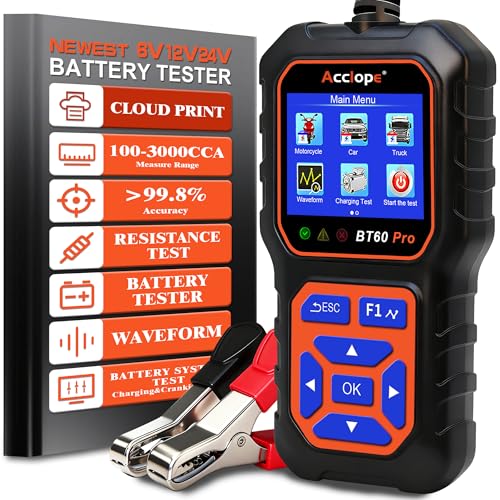
- 6V/12V/24V support
- SOH, SOC, resistance, CCA checks
- QR cloud printing for results
Best For: DIY mechanics with cars, motorcycles, and 24V vehicles
12V Diagnostic Pick

- 3-in-1 battery, cranking, and charging tests
- Supports common 12V lead-acid batteries
- Data playback for result tracking
Best For: DIYers focused on 12V cars, trucks, and small engines
Widest Range Pick
VDIAGTOOL BT500 Battery Tester

- Supports 6V, 12V, and 24V batteries
- Battery, cranking, and charging checks
- 5-in-1 protection with rugged housing
Best For: Home mechanics needing broad battery and alternator testing
Project-Farm-Noted Pick – ANCEL BA101 12V Battery and Alternator Analyzer
If you’re shopping for car battery testers for home mechanics, the ANCEL BA101 is a practical digital option for checking battery health before a no-start leaves you stranded. It reads state of health, state of charge, voltage, current, CCA, and can also run cranking and charging system tests, so you get a fuller picture of what the battery and alternator are doing.
Best For: Home mechanics who want an easy-to-read 12V tester with broad battery compatibility and charging-system checks.
Pros:
- Tests SOH, SOC, voltage, current, CCA, cranking, and charging systems.
- Works with many 12V battery types, including Flooded, AGM, GEL, and EFB.
- Classic black-and-white screen with backlight makes results easier to read.
- Built-in protection for reverse polarity, short circuit, overcurrent, and overvoltage.
Cons:
- Not compatible with lithium batteries or non-12V systems.
- Not intended for motorcycles below 30Ah.
- Requires entering the correct battery type and rating for the best results.
Overall, the BA101 is a strong fit if you want a straightforward tester that goes beyond voltage and helps you spot battery or charging problems early. Its broad 12V coverage makes it especially useful in a home garage with multiple vehicles.
Heavy-Duty Load Tester – Schumacher BT-100 6V/12V Battery Load Tester
For home mechanics comparing car battery testers for home mechanics, the Schumacher BT-100 stands out as a traditional load tester with a more hands-on diagnostic approach. It can analyze battery condition, test the charging system, and check starter motor draw, which helps you understand whether the problem is the battery, alternator, or starter.
Best For: DIYers who want a rugged load tester with battery, charging, and starter diagnostics.
Pros:
- Performs battery analysis, charging system testing, and starter motor testing.
- Supports 6V and 12V batteries up to 1000 cranking amps.
- Heavy-duty steel case and insulated handle add durability.
- Works with cars, trucks, RVs, boats, motorcycles, ATVs, and lawn tractors.
Cons:
- Bulkier and heavier than compact digital testers.
- Uses a traditional meter face instead of an LCD readout.
- Initial burn-in may produce a little smoke or odor.
The BT-100 is a solid choice if you prefer a classic load-testing tool and want more than a quick voltage check. It is best suited to users who value durability and direct, load-based diagnostics in a garage setting.
Compact Plug-and-Test Option – MOTOPOWER MP0514A 12V Digital Tester
If you want a simple tool among car battery testers for home mechanics, the MOTOPOWER MP0514A keeps the process quick with a plug-and-test design. It reads battery status before starting and alternator status after starting, making it useful for checking whether a battery needs attention or if the charging system is behaving normally.
Best For: Drivers and DIYers who want a compact, easy-to-use voltage and alternator checker.
Pros:
- Plug-and-test design keeps setup simple.
- 0.01-volt LCD accuracy plus 8 LED status indicators.
- Reverse connection and over-voltage protection add safety.
- Compact, lightweight body with a 50cm extension cable and 30A clips.
Cons:
- Designed for 12V vehicle batteries rather than broader battery types.
- Focuses on voltage and charging-system checks, not load testing.
- Less informative than multi-function analyzers for deeper diagnosis.
The MP0514A is a good fit if you want a small, low-fuss tester that tells you the basics fast. It works best as a simple garage or emergency tool for checking battery and alternator status without a complicated setup.
Versatile Load Tester – QWORK 12V 100A Battery and Voltage Tester
Among car battery testers for home mechanics, the QWORK 12V 100A tester is a practical choice if you want a compact load tester that also handles voltage and alternator checks. It supports 6V and 12V batteries up to 1,000 CCA and is aimed at users who need a straightforward diagnostic tool for common garage vehicles.
Best For: Garage users who want a compact load tester with alternator-check capability.
Pros:
- Tests 6V and 12V batteries with up to 1,000 CCA support.
- Includes an alternator testing function.
- Shock-resistant steel case is built for regular use.
- Heavy-duty copper-plated clamps and handle improve convenience.
Cons:
- Measurement type is listed only as voltmeter or related.
- Warranty details are not specified.
- Less detailed feature information than some competing testers.
The QWORK tester makes sense if you want a simple, portable load tester for cars, trucks, RVs, and golf carts. It covers the core checks needed in a home garage without adding unnecessary complexity.
Simple 12V Reader – MOTOPOWER MP0515A Battery Tester
If you want a straightforward option among car battery testers for home mechanics, the MOTOPOWER MP0515A covers the basics without adding extra complexity. It is built for 12V car batteries and checks battery condition plus cranking and charging system performance, making it a practical garage tool for routine troubleshooting.
Best For: Home mechanics who want a compact 12V tester for quick battery, starting, and charging checks.
Pros:
- Tests 12V batteries rated from 100-2000 CCA.
- Includes cranking and charging system testing.
- Compact 340 g design with a storage bag included.
- Backed by a 2-year manufacturer warranty.
Cons:
- Only supports 12V car batteries.
- Uses a basic multimeter-style measurement approach.
Overall, this is a sensible pick if you mainly need a no-fuss tester for standard 12V garage use. It focuses on core diagnostic tasks and stays portable enough to keep near your workbench or in the car.
All-Around Value Scanner – KONNWEI KW208 12V Analyzer
The KONNWEI KW208 is a strong value choice in car battery testers for home mechanics who want broad 12V coverage and quick results. It supports 12V batteries from 100-2000 CCA, works with flooded, AGM, spiral AGM, and gel batteries, and also checks cranking, charging, alternator, and starter performance.
Best For: DIY users who want an affordable, feature-rich 12V tester for cars, trucks, motorcycles, boats, and more.
Pros:
- Tests 12V batteries across multiple types, including AGM and gel.
- Provides battery health, voltage, internal resistance, and charge status data.
- Supports cranking, charging, alternator, and starter tests.
- Plug-and-play design can test in-vehicle, out-of-vehicle, and even dead batteries.
Cons:
- Limited to 12V systems.
- Feature set is broad, so first-time users may need a little time to learn the screens.
For a home mechanic who wants one tester that does a lot, the KW208 is an easy recommendation. Its mix of broad compatibility, extra diagnostics, and simple hookup makes it especially useful for regular garage checks.
Heavy-Duty Dual-System Tester – ANCEL BT410 Battery Analyzer
If you need one of the more versatile car battery testers for home mechanics, the ANCEL BT410 stands out for supporting both 12V and 24V systems. It handles lead-acid and lithium batteries, including AGM, GEL, regular flooded, and EFB, while also running state-of-charge, state-of-health, cranking, and charging diagnostics.
Best For: Home mechanics who work on a wider range of vehicles and want 12V/24V and lithium compatibility.
Pros:
- Supports 12V and 24V lead-acid plus lithium batteries.
- Displays SOC, SOH, voltage, and internal resistance.
- Checks cranking and charging system performance.
- Includes reverse polarity and short-circuit protection.
Cons:
- Larger feature set may be more than needed for simple 12V-only jobs.
- Requires the battery under test for power, so it is not a standalone unit.
The BT410 is a smart pick if your garage work goes beyond one basic passenger car battery. Its wider voltage support, lithium compatibility, and protective features make it a confident choice for more varied home-mechanic use.
Multi-Voltage Pick – BT60 PRO 2–120Ah Battery Tester
If you want one of the more flexible car battery testers for home mechanics, the BT60 PRO stands out for its 6V, 12V, and 24V support. It handles common lead-acid types plus AGM, GEL, EFB, and lithium battery checks, while also giving SOH, SOC, voltage, resistance, and CCA readings on supported batteries.
Best For: DIY mechanics who need a multi-voltage tester for cars, motorcycles, and even 24V trucks.
Pros:
- Supports 6V, 12V, and 24V batteries for broad garage use
- Tests SOH, SOC, voltage, resistance, and CCA on supported lead-acid batteries
- Includes QR cloud printing for easy result sharing and record-keeping
- Dedicated 6V motorcycle mode for smaller batteries
Cons:
- Not compatible with 48V systems
- LiFePO4 support is limited to voltage/health checks, not guaranteed CCA accuracy
- Battery tester only, so it does not read or clear OBD2 codes
Overall, this is a strong choice if your home setup includes more than just a standard 12V car. The mix of wide compatibility, clear diagnostics, and easy result sharing makes it especially practical for mixed-vehicle households and serious DIY use.
12V Diagnostic Pick – TOPDON BC100 Battery Tester
The TOPDON BC100 is a practical choice for home mechanics looking for straightforward car battery testers focused on 12V systems. It covers flooded, AGM, GEL, and EFB batteries, and adds battery health, cranking, and charging system tests so you can check more than just voltage.
Best For: Home users who want a compact 12V tester with battery, cranking, and alternator checks.
Pros:
- 3-in-1 testing covers battery health, cranking, and charging systems
- Supports a wide range of 12V lead-acid battery types
- Data playback helps compare results over time
- Compact body with long cables and spark-free, reverse-polarity protection
Cons:
- Limited to 12V batteries only
- Not intended for lithium or 24V systems
- Requires correct battery type and CCA input for accurate results
If your garage mostly revolves around standard 12V vehicles, the BC100 keeps testing simple without stripping out useful diagnostics. Its compact size and playback feature make it a solid everyday tool for monitoring battery condition and alternator performance.
Widest Range Pick – VDIAGTOOL BT500 Battery Tester
For home mechanics who want broad coverage, the VDIAGTOOL BT500 is one of the more versatile car battery testers in this group. It supports 6V, 12V, and 24V batteries, including flooded, AGM, GEL, and EFB types, and it goes beyond battery testing with cranking and charging system analysis.
Best For: DIY mechanics who need one tester for cars, motorcycles, SUVs, and 24V equipment.
Pros:
- Works with 6V, 12V, and 24V batteries for wider vehicle coverage
- Checks battery health, state of charge, cranking, and charging systems
- Dedicated 6V motorcycle mode for smaller batteries
- Includes 5-in-1 protection and a shock-resistant ABS body
Cons:
- Not available for lithium, deep-cycle, or golf cart batteries
- Needs correct battery type and CCA input for accurate readings
- Bulkier than the smallest pocket-size testers
The BT500 makes sense if you work on more than one vehicle type and want a tester that can handle the variety. Its wide voltage support and built-in alternator analysis make it useful for diagnosing both weak batteries and charging problems.
How We Picked the Best Car Battery Testers for Home Mechanics
We focused on tools that make sense for everyday driveway diagnostics: clear readouts, useful test ranges, straightforward clamps or leads, and support for common 12V systems. For more advanced Car Battery Testers for Home Mechanics, we also considered alternator and cranking tests, CCA coverage, and compatibility with different battery types.
We gave extra weight to models that balance ease of use with real diagnostic value, since most home mechanics want quick answers without sacrificing accuracy.
Quick Comparison
For simple voltage and charging checks, basic digital testers are usually the easiest starting point. If you want a more complete picture of battery health, load testers and analyzer-style tools are a better fit. Multi-voltage units can be especially useful if you service motorcycles, lawn equipment, RVs, or older vehicles alongside standard passenger cars.
Key Buying Factors for Car Battery Testers for Home Mechanics
Battery and Vehicle Compatibility
Check whether the tester supports 6V, 12V, or 24V systems, and confirm it works with your battery type, such as flooded lead-acid, AGM, EFB, gel, or lithium where applicable.
CCA Range and Load Testing
Cold Cranking Amps support matters if you want a realistic health check. A wider CCA range gives you more flexibility across small cars, trucks, and powersports batteries.
Test Functions
At minimum, look for voltage testing. More useful options include cranking analysis, charging system checks, alternator testing, and battery health estimates. These functions help you tell the difference between a weak battery and a bad charging system.
Readability and Ease of Use
For home garage work, large displays, simple menus, and clearly labeled clamps reduce mistakes. QR reports or app-based summaries can be helpful, but only if they don’t make the tool harder to use.
Build Quality and Safety
Sturdy cables, solid clamps, and reverse-polarity protection are worth prioritizing. A tester that feels durable is especially important if it will live in a toolbox or garage shelf.
Who Should Buy Which Car Battery Testers for Home Mechanics?
If you want a quick, affordable way to check battery and charging health, a compact digital tester is usually enough. If you regularly diagnose older vehicles, trucks, or multiple battery types, choose a heavier-duty load tester or a unit with broader voltage support. For DIYers who want one tool that can handle more than just a basic car battery check, advanced analyzers are the best long-term value.
In short, the best choice depends on how often you test, what vehicles you work on, and whether you want simple confirmation or deeper diagnostic insight.