A damp garage can lead to musty odors, surface rust, mold growth, and damage to stored tools, vehicles, and household items. The right dehumidifier helps control excess moisture before those problems become expensive.
We selected 10 garage-capable models ranging from large residential units to high-output commercial machines, focusing on coverage, extraction capacity, drainage options, energy use, noise, and installation convenience.
Best 10 Garage Dehumidifiers Picks for 2026
Best Large-Garage Coverage

- Up to 6,000-square-foot coverage
- Continuous or tank drainage
- ENERGY STAR Most Efficient 2025
Best For: Large garages and storage areas
Best Efficiency-Focused Pick

- Rated for up to 6,000 square feet
- ENERGY STAR Most Efficient 2024
- Smart humidity and power-off memory
Best For: Large spaces prioritizing efficiency
Best Pumped Drainage

- Built-in pump with 15-foot lift
- Includes 15-foot drain hose
- Quiet operation as low as 41 dB
Best For: Garages needing remote drainage
Best Mid-Size Efficient Option
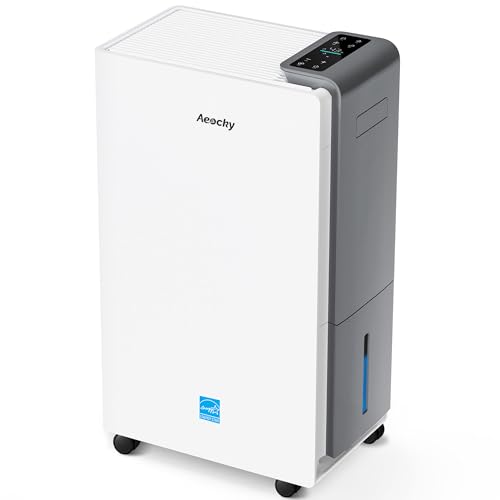
- Rated for up to 5,500 square feet
- 80-pint maximum daily capacity
- Low-temperature defrost support
Best For: Large residential garages
Best Commercial Pick
Abestorm 180 PPD LGR Dehumidifier
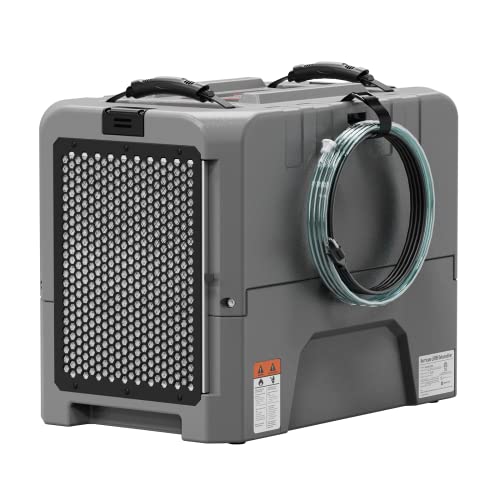
- Commercial LGR unit rated up to 180 pints per day
- Built-in pump with 19.6-foot drain hose
- Stackable design with auto-defrost and humidity control
Best For: Large garages and demanding moisture-removal jobs
Best Quiet Residential Option

- Up to 80 pints per day with 5,500-square-foot coverage
- 40–45 dB operation and adjustable humidity settings
- Included hose supports continuous drainage
Best For: Large home garages near living spaces
Best Flexible Everyday Pick

- Adjustable 45–80-pint output for up to 4,500 square feet
- Tank and drain-hose options for flexible use
- 40 dB operation with sleep mode and auto-defrost
Best For: Residential garages needing adaptable, quiet moisture control
Best Overall Coverage
Waykar 80-Pint Garage Dehumidifier
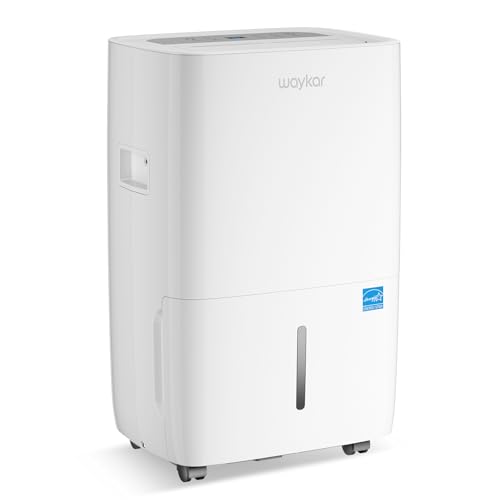
- Covers up to 5,000 square feet
- 90-degree auto-swing airflow
- ENERGY STAR certified with flexible drainage
Best For: Large garages and basements needing broad, even moisture control
Quietest Pick
4,500-Square-Foot Garage Dehumidifier

- Covers up to 4,500 square feet
- Rated at 40 dB with sleep mode
- Adjustable airflow and continuous-drain hose included
Best For: Garages and work areas where low noise and directed drying matter
Best Drainage Flexibility
Gasbye DryPrime 115-Pint Dehumidifier
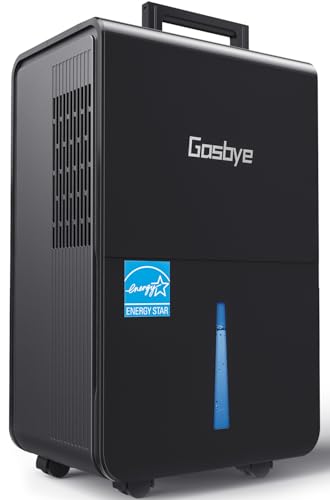
- Three drainage options for flexible installation
- Up to 115 pints per day under stated conditions
- ENERGY STAR 2026 with automatic restart
Best For: Large garages needing hands-off, continuous moisture removal
Best Large-Garage Coverage – 140-Pint Vellgoo Dehumidifier
For expansive garages and other damp areas, this garage dehumidifier combines high stated moisture-removal capacity with adjustable humidity control. It is rated for spaces up to 6,000 square feet and supports either tank-based or continuous drainage.
Best For: Large garages, basements, storage areas, and humid homes needing long-running moisture control.
Pros:
- Rated to remove up to 140 pints per day under specified test conditions.
- Includes a 6.56-foot drain hose and supports a standard 3/4-inch garden hose connection.
- Offers continuous, custom, and sleep modes, plus auto restart and memory functions.
- ENERGY STAR Most Efficient 2025 model with auto defrost and a washable filter.
Cons:
- The included tank holds 1.65 gallons, so manual emptying may be frequent in very damp conditions.
- The unit is relatively tall at 24.41 inches and weighs 38.6 pounds.
This is a strong fit when coverage and flexible drainage matter most. Its wheels and side handles help with repositioning, while the humidity controls reduce the need for constant monitoring.
Best Efficiency-Focused Pick – AEOCKY RHEA-002
This AEOCKY garage dehumidifier is designed for large spaces up to 6,000 square feet, with an emphasis on verified ENERGY STAR Most Efficient 2024 performance. Its compressor system and smart humidity control are aimed at efficient, consistent operation.
Best For: Large garages or commercial-style spaces where energy efficiency and precise humidity management are priorities.
Pros:
- Rated at up to 105 pints per day at 95°F and 95% relative humidity.
- ENERGY STAR Most Efficient 2024 certification is highlighted in the supplied specifications.
- Uses smart humidity detection and a power-off memory function.
- Features a high-efficiency compressor design with copper heat-exchange tubing.
Cons:
- The supplied notes do not provide complete details about tank capacity, hose inclusion, or dimensions.
- Some claimed savings and performance figures depend on stated test conditions and usage.
Choose this model when efficiency credentials and automated humidity control outweigh the need for a fully detailed drainage setup. Confirm the included accessories and installation requirements before buying.
Best Pumped Drainage – avylo 90-Pint Dehumidifier
For garages without a convenient floor drain, this garage dehumidifier stands out with a built-in pump and included 15-foot hose. It is rated for large areas, provides three drainage options, and adds low-temperature operation and safety features for extended use.
Best For: Garages and basements needing unattended operation with pumped or continuous drainage.
Pros:
- Rated for up to 90 pints per day and areas up to 5,000 square feet.
- Built-in pump provides a 15-foot lift, and a 15-foot drain hose is included.
- Large 2.11-gallon tank includes a full-tank reminder and automatic shutoff.
- ENERGY STAR Most Efficient 2025 model with operation as quiet as 41 dB.
Cons:
- A floor drain pipe is not included.
- The supplied details list both 4,500- and 5,000-square-foot coverage figures, so actual suitability may depend on conditions.
The pump is the main advantage here, especially for a garage where gravity drainage is impractical. Its timer, child lock, and compressor protections also make it a practical choice for longer unattended runs.
Best Mid-Size Efficient Option – AEOCKY RHEA-001
This AEOCKY garage dehumidifier offers a middle ground between high coverage and manageable capacity. It is rated for up to 5,500 square feet and emphasizes ENERGY STAR Most Efficient 2025 efficiency, accurate humidity sensing, and reliable lower-temperature performance.
Best For: Large residential garages that need efficient operation and smart humidity control without the highest-capacity unit.
Pros:
- Rated at up to 80 pints per day at 95°F and 95% relative humidity.
- ENERGY STAR Most Efficient 2025 certification is highlighted.
- Smart humidity detection and power-off memory support automatic operation.
- Designed to continue operating in lower-temperature conditions with defrost sensors.
Cons:
- The supplied notes do not specify tank volume, drainage accessories, or dimensions.
- The stated 56-pint warm-basement capacity is lower than the maximum rating.
This model makes sense for buyers who want broad garage coverage and efficiency-focused features in a somewhat smaller capacity class. Check drainage details before installation, particularly if the unit will run unattended.
Best Commercial Pick – Abestorm 180 PPD LGR Dehumidifier
For large, seriously damp garages, the Abestorm is a commercial-grade option among garage dehumidifiers. Its high-capacity LGR design, built-in pump, and included drain hose are suited to extended operation in spaces with reliable drainage.
Best For: Large garages, workshops, warehouses, crawl spaces, and other demanding moisture-control jobs.
Pros:
- Rated to remove up to 180 pints per day under the stated test conditions, with coverage up to 16,100 cubic feet.
- Built-in pump and 19.6-foot drain hose support continuous drainage, with water lifted up to 14.7 feet.
- Touch controls, adjustable humidity from 25% to 80%, auto-stop, and auto-defrost operation.
- Portable stackable design with a ridged handle and replaceable MERV-8 filter.
Cons:
- At 70.8 pounds, it is substantially heavier than typical residential units.
- Its commercial capacity and 1,150-watt power draw may be more than a small garage needs.
The Abestorm stands out when moisture levels are high or the garage is unusually large. Choose it if dependable pumped drainage and commercial performance matter more than compact size and lower energy use.
Best Quiet Residential Option – KNKA 80 Pint Dehumidifier
The KNKA offers a residential approach to garage dehumidifiers, combining substantial moisture removal with quieter operation and selectable modes. Its continuous-drain hose can reduce tank maintenance when a suitable floor drain is available.
Best For: Large residential garages that need adjustable humidity control, quieter operation, and flexible drainage.
Pros:
- Removes up to 80 pints per day in the stated high-humidity conditions and is listed for spaces up to 5,500 square feet.
- Offers a 1.45-gallon tank, included 6.56-foot drain hose, and optional external tank support.
- Designed for 40–45 dB operation, with a display and indicator lights that can be turned off.
- AUTO, DRY, and SETTING modes provide humidity targets from 30% to 80%, plus a child lock and 12-hour timer.
Cons:
- The optional 2.64-gallon external tank is sold separately.
- The supplied specifications list 220 volts, so garage electrical compatibility should be confirmed before purchase.
KNKA is a practical fit for homeowners who want strong capacity without a commercial unit’s bulk. Its quieter design and humidity-focused controls are especially useful when the garage connects to living areas.
Best Flexible Everyday Pick – 4500 Sq. Ft. Dehumidifier
This flexible unit is a well-rounded choice among garage dehumidifiers for homeowners who want broad coverage, automatic humidity management, and two drainage options. Its quiet setting and safety features also make it suitable for garages that double as work or storage areas.
Best For: Residential garages with up to 4,500 square feet of coverage and access to either a floor drain or regular tank-emptying.
Pros:
- Provides adjustable 45–80-pint dehumidification output for spaces up to 4,500 square feet.
- Includes both a removable water tank and drain hose for manual or continuous gravity drainage.
- Smart humidity sensors, five working modes, auto-defrost, and a 24-hour programmable timer support hands-off operation.
- Listed at 40 dB, with sleep mode, child lock, full-tank alert, and automatic shutoff.
Cons:
- Gravity drainage requires a suitable nearby drain and the correct hose placement.
- The supplied notes do not specify the tank capacity or unit dimensions.
With its adjustable output and dual drainage setup, this model is easier to tailor to changing garage conditions than a fixed-capacity unit. It is a strong everyday option when quiet operation and automatic safeguards are priorities.
Best Overall Coverage – Waykar 80-Pint Garage Dehumidifier
The Waykar 80-pint is a strong option among garage dehumidifiers for large, damp spaces. It is rated to cover up to 5,000 square feet, offers adjustable humidity control down to 30% RH, and includes both tank and continuous-drain options.
Best For: Large garages, basements, RVs, and other spaces that need broad moisture coverage and flexible humidity settings.
Pros:
- Rated for up to 5,000 square feet and 80 pints per day under stated test conditions
- 90-degree auto-swing airflow helps distribute dry air more evenly
- ENERGY STAR certified, with auto defrost and overload protection
- Includes a 4.3-liter tank and drain hose for flexible setup
Cons:
- The tank may require regular emptying when continuous drainage is unavailable
- The included drain hose is only 3.3 feet long
Choose this Waykar when coverage and airflow distribution matter most. Its 42 dB operating claim and 24-hour timer also make it practical for extended use near living areas.
Quietest Pick – 4,500-Square-Foot Garage Dehumidifier
This 4,500-square-foot model is one of the more appealing garage dehumidifiers for users who want high capacity without as much operating noise. It combines a claimed 45-to-80-pint range with 90-degree adjustable airflow, ENERGY STAR certification, and a continuous-drain hose.
Best For: Garages, basements, gyms, and laundry areas where quiet operation and directed airflow are priorities.
Pros:
- Designed to cover up to 4,500 square feet
- 40 dB operation and a dedicated sleep mode support quieter use
- 90-degree adjustable outlet can direct air toward corners or wet laundry
- Includes a 1.72-gallon tank, drain hose, wheels, washable filter, and auto protection features
Cons:
- Its stated capacity varies from 45 to 80 pints depending on conditions
- The 1.72-gallon tank can fill faster during heavy moisture removal
This is a sensible pick if a garage shares a wall with living space or doubles as a workspace. The wheels simplify repositioning, while the hose option can reduce tank-emptying chores.
Best Drainage Flexibility – Gasbye DryPrime 115-Pint Dehumidifier
The Gasbye DryPrime stands out among garage dehumidifiers for its three drainage choices and clearly stated performance figures. It is designed for spaces up to 4,500 square feet, with output claims ranging from 50 pints per day at cooler test conditions to 115 pints at 86°F and 80% RH.
Best For: Large garages and basements that need continuous drainage, automatic restart, and a robust high-capacity design.
Pros:
- Offers three drainage methods: 1.7-gallon tank, included 5-foot hose, or standard 3/4-inch garden hose
- ENERGY STAR 2026 certified and rated at 500 watts
- Automatic shutoff and restart respond to humidity changes and power interruptions
- Reinforced copper tubing and a 43-pound solid build are intended for durability
Cons:
- At 43 pounds, it is heavier than many smaller portable units
- Its 24-inch height and 15-inch width may require more floor space
- Operating noise is listed at approximately 45 dB
Pick the DryPrime when drainage setup and extended operation are more important than compactness. Its auto-restart and multiple hose configurations are especially useful in garages with a nearby floor drain.
How We Picked These Garage Dehumidifiers
We focused on models suitable for the larger, less-controlled environment of a garage rather than compact bedroom units. Selection criteria included stated coverage area, moisture-removal capacity, continuous-drain compatibility, built-in pumps, energy-efficiency claims, operating noise, portability, and suitability for unfinished or frequently damp spaces.
Because manufacturer pint ratings can vary by testing conditions, treat capacity figures as useful comparisons rather than guarantees. Real-world performance depends on temperature, humidity, insulation, air circulation, and whether doors are opened frequently.
Quick Comparison
- Best for very wet spaces: Commercial LGR units with higher extraction rates and robust drainage systems.
- Best for most large garages: 70- to 80-pint residential models with hose connections and automatic humidity control.
- Best for unattended operation: Units with continuous drainage, internal pumps, auto-restart, and full-tank protection.
- Best for quieter use: Residential compressor models marketed around 45 dB, although actual noise varies by fan speed and room acoustics.
Key Buying Factors for Garage Dehumidifiers
Capacity and Garage Size
Match the unit to both square footage and moisture load. A well-sealed, moderately humid garage may work well with a large residential model, while a basement-style garage, flood-prone area, or space with wet concrete may need commercial-grade output. Oversizing can also help the unit reach target humidity faster, but it may cost more upfront.
Drainage and Pump Options
Continuous drainage is often more important than tank size. Check whether the hose connection can reach a floor drain or sump and whether gravity drainage is practical. If the drain is higher than the appliance, choose a model with a built-in pump or plan for a compatible external pump. Verify hose fittings and included accessories before installation.
Temperature, Energy Use, and Controls
Garages can become cold, and standard compressor dehumidifiers may lose efficiency or require a low-temperature operating feature. Look for automatic defrost, adjustable humidity controls, auto-restart after outages, and an Energy Star rating when lower operating costs matter. Keep doors and windows closed as much as practical to reduce runtime.
Noise, Mobility, and Maintenance
Wheels and handles make heavy units easier to reposition, while washable filters help protect performance. Leave clearance around air intakes and exhausts, clean the filter regularly, and inspect the drain line for kinks or blockages. Commercial machines are typically louder and heavier but better suited to severe moisture problems.
Who Should Buy Which Garage Dehumidifiers?
Choose a high-capacity residential unit if you need everyday humidity control in a large attached or detached garage and want a balance of price, convenience, and energy use.
Choose a model with a pump if your garage lacks a low floor drain or you plan to run the appliance continuously while away from home.
Choose a commercial LGR dehumidifier for restoration work, persistent water intrusion, very damp concrete, or demanding jobsite conditions where faster moisture removal and rugged construction justify the added cost.
Before buying, measure the garage, identify the drainage route, check the expected temperature range, and confirm the outlet can support the appliance. These details usually matter more than the headline pint rating alone.