If you work on vehicle electrical issues, the right car circuit tester can save hours of guesswork. From simple voltage checks to tracing shorts and testing fuse circuits, these tools make diagnostics faster and more precise.
Below, we’ve rounded up 10 of the best options for 2026, with a practical buying guide to help you choose the right tester for your needs and budget.
Best 10 Car Circuit Tester Picks for 2026
Best for Clear Voltage Readouts

- Digital voltage display with 0.1V resolution
- Dual-color polarity indicator for quick checks
- 3V-48V range suits cars, trucks, SUVs, and boats
Best For: DIY drivers and weekend mechanics who want a simple tester with a clear voltage readout.
Best for Advanced Diagnostics
Autel PowerScan Circuit Tester

- Supports voltage, polarity, continuity, resistance, and AC/DC tests
- Can activate components to help verify motors, lights, fans, and injectors
- Long cable setup improves reach around larger vehicles
Best For: DIYers and technicians who want an all-in-one automotive probe for deeper electrical diagnostics.
Best for Simple Fuse-Slot Checks
Car Circuit Tester Fuse Tester

- Real-time current readings for quick diagnostics
- Compact, portable design for workshop or roadside use
- Durable, waterproof build for automotive environments
Best For: DIYers and technicians who need a portable blade-fuse current tester for vehicles.
Best for Small Spaces
Autel PowerScan Circuit Tester

- All-in-one electrical testing and component activation
- Long 20 ft cable with extension for better reach
- Built-in protection for safer short-circuit tracing
Best For: Technicians and serious DIYers who need a versatile probe for complex automotive electrical diagnostics.
Best for Fast Fuse Diagnostics
High-Precision Car Fuse Tester

- 0.01A to 19.99A measurement range
- LCD display with current-direction indication
- Built-in front light for low-light use
Best For: DIYers and technicians diagnosing fuse circuits and parasitic battery drain.
Best for Wiring Fault Detection
Automotive Circuit Tracer & Wire Tracker

- Finds shorts and open circuits in 6–42V DC systems
- Traces hidden wires without removing insulation
- Comes with probe, transmitter, leads, clips, and case
Best For: DIYers and techs diagnosing hidden wiring faults in cars, trailers, RVs, motorcycles, and boats.
Best for Fuse-Level Diagnostics
Automotive Fuse Fault Probe Tester

- 0.01A–20A real-time current measurement
- Finds the fuse causing parasitic battery drain
- Works with mini and standard blade fuses
Best For: DIYers and techs diagnosing battery drain or abnormal fuse-circuit current.
Best for Full Diagnostic Coverage
VDIAGTOOL V200 Pro Circuit Tester

- All-in-one diagnostics for voltage, continuity, resistance, and diode tests
- Wire tracing and breaker-finder modes help track hard-to-find faults
- Long reach and overload protection make it practical for vehicle use
Best For: DIYers and techs who need a versatile tester for deeper vehicle electrical troubleshooting.
Best for Long-Reach Diagnostics
ANCEL PB100 Power Circuit Probe
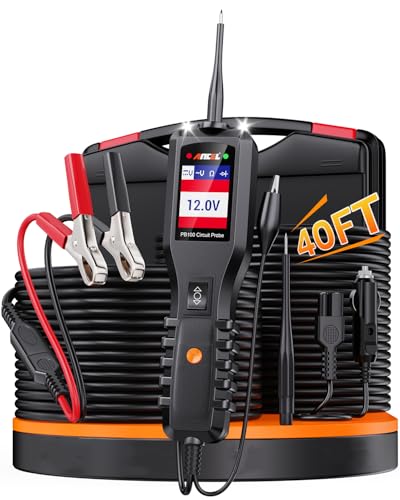
- 40-foot reach for long vehicles and trailer wiring
- All-in-one testing for voltage, continuity, resistance, and more
- LED and tone alerts simplify quick fault checks
Best For: DIYers and mobile mechanics who need a long-reach, all-in-one tester.
Best for Tight Access
EM415Pro 6-42V Circuit Breaker Finder

- Audible transmitter/receiver feedback
- 7-inch flexible probe for cramped areas
- 6-42V DC support for car and home use
Best For: DIYers and techs tracing wiring in tight automotive or household spaces.
Best for Clear Voltage Readouts – WINAMOO 3-48V Test Light
If you want a car circuit tester that makes quick sense at a glance, this WINAMOO test light stands out for its bright digital voltage display, polarity indication, and broad 3V-48V support. It’s built for fast checks on batteries, charging systems, fuses, lights, and other common automotive circuits without a lot of guesswork.
Best For: DIY drivers and weekend mechanics who want a straightforward tester with a clear voltage readout and polarity feedback.
Pros:
- Bright digital display with 0.1V resolution for easy readings
- Dual-color polarity indication helps confirm positive vs. negative quickly
- Sharp stainless probe and long spring wire improve reach and access
- Works across 3V-48V systems for cars, trucks, SUVs, boats, and more
Cons:
- Not as specialized as a full multimeter for advanced diagnostics
- Probe-style testing may be less ideal for users who prefer clamp-only tools
For routine electrical troubleshooting, this car circuit tester offers a practical mix of clarity, reach, and everyday versatility. It’s a smart pick if you value simple voltage checks and polarity confirmation over advanced diagnostic features.
Best for Advanced Diagnostics – Autel PowerScan Circuit Tester
If you want a car circuit tester that does more than basic continuity checks, the Autel PowerScan is built for deeper electrical diagnosis. It combines voltage, resistance, AC/DC testing, polarity detection, and component activation in one handheld tool, making it useful for both quick fault checks and more involved troubleshooting.
Best For: DIYers, technicians, and enthusiasts who want an all-in-one probe for tracing shorts, checking grounds, and activating components.
Pros:
- Tests 6-30V vehicle systems with voltage, polarity, continuity, resistance, and AC/DC functions
- Component activation helps verify motors, lights, fans, injectors, and other electrical parts
- Long 20 ft cable plus extra extension makes it easier to reach around larger vehicles
- Clear tone and LED indicators help with fast diagnosis in tight or dim spaces
Cons:
- More advanced than a simple test light, so it may be overkill for basic users
- Best suited to vehicle electrical work rather than general household testing
Overall, this car circuit tester stands out for buyers who want professional-style diagnostic features without juggling multiple tools. If your priority is finding shorts, confirming circuit behavior, and activating components from one probe, it offers a strong all-in-one setup.
Best for Simple Fuse-Slot Checks – Car Circuit Tester Fuse Tester
If you want a car circuit tester that measures current through a blade fuse slot, this compact model is built for straightforward automotive diagnostics. It offers real-time readings, a portable body, and a high-resolution display for spotting current changes quickly in vehicles and small workshop jobs.
Best For: DIYers and technicians who need a portable fuse-slot tester for checking automotive current up to 20A/48V.
Pros:
- Real-time current measurement helps pinpoint electrical issues fast.
- Compact, lightweight design is easy to carry between vehicles.
- Durable, waterproof build suits workshop and roadside use.
- Works with blade fuses for practical in-circuit testing.
Cons:
- Limited to current measurement, not a full-featured multimeter.
- Max 20A/48V rating means it is not for heavy-duty circuits.
- Requires careful setup and ignition-off handling before connecting.
For buyers who mainly need a car circuit tester for blade-fuse current checks, this is a focused, portable option. It is best when you want quick diagnostics without extra complexity, but the 20A limit means it is aimed at light- to mid-level automotive testing rather than broader electrical work.
Best for Small Spaces – Autel PowerScan Circuit Tester
If you want a car circuit tester that goes beyond basic voltage checks, the Autel PowerScan is built for more serious electrical troubleshooting. It combines probing, polarity checks, continuity testing, component activation, and short-fault location in one handheld tool, making it a strong fit for both DIY repairs and shop use.
Best For: Technicians and experienced DIYers who need an all-in-one probe for diagnosing wiring faults, checking components, and tracing shorts on 12-24V vehicle systems.
Pros:
- Supports voltage, resistance, AC/DC, duty cycle, and polarity testing in one unit
- Can activate components like motors, lights, wipers, and fuel injectors
- Includes a 20 ft cable plus extension for easier reach around larger vehicles
- Built-in circuit protection adds safety during overloads and short testing
Cons:
- More tool than casual users need for simple fuse or battery checks
- Higher learning curve than basic test lights or simple multimeters
For anyone who regularly diagnoses wiring issues, this car circuit tester stands out for its range of functions and practical reach. It is especially useful when you need fast fault-finding and component testing in one tool rather than juggling multiple devices.
Best for Fast Fuse Diagnostics – High-Precision Car Fuse Tester
If you want a practical car circuit tester for chasing parasitic drain and checking fuse-fed circuits, this model stands out for its 0.01A to 19.99A measurement range and clear LCD readout. It’s built for quick fault-finding in everyday garage work, roadside checks, and general vehicle electrical troubleshooting.
Best For: DIYers and technicians who need a compact tester for diagnosing fuse circuits and battery drain issues.
Pros:
- Measures current from 0.01A to 19.99A for more precise fault tracing
- LCD display shows current direction and is easier to read in dim spaces
- Front light helps with testing in garages or roadside conditions
- Portable design is easy to keep in a glove box or tool bag
Cons:
- 20A max load limit means it’s not for heavy-duty current testing
- Requires following the fuse-swap setup, which may slow first-time users
- Best suited to fuse-based diagnostics rather than broad electrical system testing
Overall, this car circuit tester is a solid pick if your main goal is identifying fuse-circuit problems and overnight battery drain with a simple, portable tool. The precision range and illuminated display make it especially useful when you need quick answers without bulky diagnostic gear.
Best for Wiring Fault Detection – Automotive Circuit Tracer & Wire Tracker
If you need a car circuit tester that can do more than basic continuity checks, this EM415PRO kit is built for finding shorts, opens, and hidden wire runs in 6–42V DC systems. It’s especially useful when the fault is buried behind trim, under carpets, or deep in an engine bay.
Best For: DIYers and technicians who need a wire tracer and circuit tester for diagnosing open or short circuits in cars, trailers, RVs, motorcycles, and boats.
Pros:
- Detects open circuits and shorts across 6–42V DC systems
- Non-invasive wire tracing helps follow hidden wiring without stripping insulation
- Includes transmitter, probe, leads, clips, batteries, and a carry case
- Compact probe design is helpful in tight automotive spaces
Cons:
- Designed for DC systems only, not general household electrical work
- More specialized than a simple test light for quick checks
- May take some practice for first-time users to interpret signals accurately
For buyers who want a practical car circuit tester for tracing wires and isolating faults, this kit offers a strong mix of reach, accessory value, and diagnostic flexibility. It’s a good fit when you need to move beyond basic continuity testing and actually pinpoint where the wiring problem lives.
Best for Fuse-Level Diagnostics – Automotive Fuse Fault Probe Tester
If you want a practical car circuit tester for tracking down battery drain, this inline fuse probe makes the process much simpler. It checks current at the fuse slot, so you can pinpoint the circuit causing parasitic draw without disconnecting the battery or juggling loose meter leads.
Best For: DIY drivers and technicians who need to isolate parasitic battery drain or abnormal fuse-circuit current quickly and accurately.
Pros:
- Measures 0.01A to 20A for real-time current checks on fuse circuits
- Helps identify the exact fuse causing parasitic draw without battery disconnection
- Inline design keeps factory fuse protection active during diagnosis
- Compatible with mini and standard blade fuses for broad vehicle use
Cons:
- Focused on fuse-slot diagnostics, not full multimeter-style testing
- May be more tool than casual users need for simple voltage checks
This car circuit tester is a strong fit when the goal is fast, fuse-level troubleshooting instead of general electrical testing. Its real value is helping you move from guesswork to a specific circuit in less time.
Best for Full Diagnostic Coverage – VDIAGTOOL V200 Pro Circuit Tester
If you want a car circuit tester that can handle more than basic voltage checks, the VDIAGTOOL V200 Pro is built for broad electrical troubleshooting. It combines probe testing, wire tracing, breaker finding, component activation, and multiple circuit tests in one kit, making it useful for everything from blown fuses to hidden shorts.
Best For: DIYers, mobile techs, and vehicle owners who need an all-in-one tester for diagnosing open circuits, shorts, relays, sensors, and trailer wiring.
Pros:
- Wide test coverage: voltage, continuity, resistance, diode, polarity, and more
- Breaker-finder and wire-tracing modes help locate faults without damaging insulation
- Long 20 ft cord plus extension gives better reach around larger vehicles
- Built-in overload protection adds a layer of safety for the tool and vehicle electronics
Cons:
- More advanced than a basic test light, so it may take time to learn
- Best suited to 12V/24V vehicle systems, not general household use
For shoppers who want a car circuit tester that can do real diagnostic work, this is a strong all-in-one option. Its biggest advantage is versatility, especially if you regularly chase shorts, open wires, or intermittent electrical problems across different vehicles.
Best for Long-Reach Diagnostics – ANCEL PB100 Power Circuit Probe
If you need a practical car circuit tester that can reach long vehicles, trailers, and hard-to-access wiring, the ANCEL PB100 is built for fast everyday diagnostics. It combines voltage, continuity, polarity, resistance, diode, and component activation functions in one tool, so you can trace faults without swapping between multiple testers.
Best For: DIYers, mobile mechanics, and trailer owners who want an all-in-one tester with extra reach and simple operation.
Pros:
- 40-foot total reach with the included extension cable for larger vehicles and trailer work
- Handles voltage, continuity, resistance, polarity, and component activation in one tool
- Clear LED and tone alerts make circuit checks easier to read quickly
- Built-in auto circuit breaker adds protection during overloads and short tests
Cons:
- Less compact than a basic test light or pocket-sized meter
- More feature-rich than some casual users may need for simple checks
Overall, the PB100 is a strong pick if you want a car circuit tester that can do more than just spot voltage. Its long cables, straightforward controls, and component-testing ability make it especially useful for diagnosing wiring problems without a lot of guesswork.
Best for Tight Access – EM415Pro 6-42V Circuit Breaker Finder
If you need a car circuit tester that can quickly locate opens, shorts, and hidden wiring paths, the EM415Pro is built for practical diagnostics. Its transmitter-and-receiver setup helps you trace circuits without damaging insulation, while the flexible probe makes it easier to reach cramped areas in vehicles and around the house.
Best For: Drivers, DIYers, and techs who need to trace wiring in tight dashboard, fuse box, or harness spaces.
Pros:
- Traces open circuits and shorts with audible feedback for faster troubleshooting
- 7-inch flexible probe helps reach tight spots in dashboards and panels
- Works across 6-42V DC systems for automotive and light electrical use
- No wire piercing required, which is safer for insulation and harnesses
Cons:
- Designed for DC systems, so it is not a fit for AC troubleshooting
- May be more tool than casual users need for simple battery checks
Overall, this car circuit tester stands out for tracing ability and access in tight spaces rather than advanced features. If your priority is finding broken wires or hidden circuit paths fast, it offers a very practical mix of range, flexibility, and safe non-contact use.
How We Picked These Car Circuit Testers
We focused on tools that solve real-world automotive electrical problems: checking voltage, identifying opens and shorts, testing fuses, tracing wires, and monitoring current draw. We also looked for clear displays, practical voltage ranges, solid probe design, and features that make troubleshooting easier in both DIY and professional settings.
Because different jobs call for different tools, this roundup includes basic test lights, advanced power probes, fuse testers, and circuit tracers. That gives buyers a wider range of options depending on whether they need simple confirmation or deeper electrical diagnosis.
Quick Comparison
If you only need quick power and ground checks, a basic digital test light may be enough. If you regularly diagnose blown fuses, intermittent faults, parasitic draw, or open/short circuits, a more advanced Car Circuit Tester with current and resistance functions will be the better long-term choice.
Circuit tracers are best when the issue is buried in wiring, while fuse-specific testers are ideal for fast checks at the fuse box. Match the tool to the diagnostic task rather than choosing the most feature-heavy model by default.
Key Buying Factors for a Car Circuit Tester
Voltage Range and Vehicle Compatibility
Most passenger cars use 12V systems, but many testers also support 24V, which matters for trucks, commercial vehicles, and some marine applications. If you want broader usefulness, look for a Car Circuit Tester that covers both 12V and 24V.
Diagnostic Functions
Basic testers confirm power and polarity. More advanced tools can measure current, detect shorts and opens, test continuity, and sometimes help identify parasitic draw. Choose based on how deep you need to go into the electrical system.
Display and Readability
Digital voltage and current readouts are easier to interpret than simple indicator lights, especially when chasing intermittent faults. Bright LED displays can also help in low-light garage conditions.
Probe and Lead Quality
Durable tips, flexible leads, and comfortable handles matter more than they seem. A tester that is awkward to hold or hard to connect can slow down diagnosis and create frustration.
Safety and Control
For powered probes, look for overload protection, polarity indication, and clear operating controls. These features are especially helpful when testing sensitive circuits or working around modern vehicle electronics.
Who Should Buy Which Car Circuit Tester?
DIY owners who mainly need to confirm voltage or check fuses should start with a simpler digital tester or fuse tester. Weekend mechanics who want a more versatile tool should consider a midrange power probe with short/open detection. Technicians and serious troubleshooters will usually get the most value from a full-featured Car Circuit Tester that includes current measurement, tracing, and broader vehicle compatibility.
If wiring faults are your biggest headache, prioritize a circuit tracer. If you often diagnose no-start, blown fuse, or battery drain complaints, a tester with amperage and parasitic draw capabilities is likely the smarter purchase.