Upgrading a factory audio system does not have to mean replacing the head unit. The right amplifier or line-output converter can add cleaner power, better bass, and more control while keeping your original stereo.
This roundup focuses on car amplifiers for factory stereos that are practical for everyday upgrades, from simple signal conversion to stronger multi-channel amplification.
Best 10 Car Amplifiers for Factory Stereos Picks for 2026
Factory Stereo Upgrade Interface
Kicker KISLOC2 Line-Out Converter

- Converts speaker-wire output to RCA line-level signal
- Adds a 12-volt remote turn-on output
- Accepts up to 55 watts of input signal
Best For: Adding an amplifier to an OEM stereo with speaker-level inputs
Flexible OEM Power Pick
Taramps TS 400X4 4-Channel Amp

- 400W RMS Class D amplifier with efficient output
- High-level auto turn-on plus RCA inputs
- Built-in HPF, LPF, and full-range modes
Best For: Connecting a compact 4-channel system to factory or aftermarket stereos
Signal Conversion Helper
Scosche LOC2SL with Remote Knob
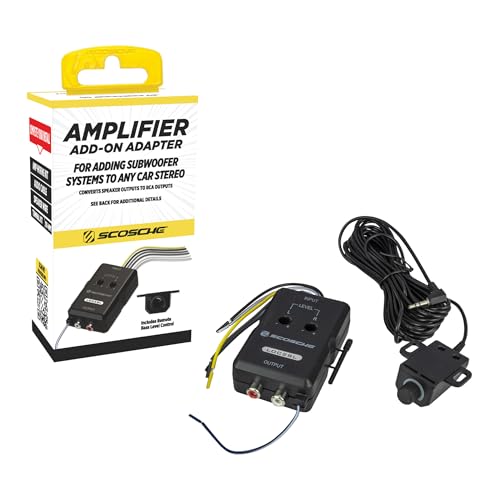
- Converts speaker-level audio to 2-channel RCA
- Includes a remote control knob
- Compact design with lifetime tech support
Best For: Factory stereo installs needing a high-to-low converter with easy level control
High-Power Bass Driver
Pioneer GM-A5702 2-Channel Amp

- 1,000 watts max power output
- Bridgeable to 480 watts RMS x 1
- Variable low-pass filter and bass boost
Best For: Powering a bridged subwoofer setup from a factory stereo install
Factory Stereo Upgrade
High to Low Converter for Factory Stereo Amp

- Converts speaker-level to low-level outputs
- Works with most factory stereos without preamp outs
- Compact, direct-wire installation for tight spaces
Best For: adding an amp or subwoofer to an OEM radio
Power-First Pick
Pioneer GM-A3702 2-Channel Car Amp

- 500W max output with 60W RMS x 2 at 2 ohms
- Bridgeable for 190W RMS x 1 in bridged mode
- Automatic signal sensing and built-in filtering
Best For: a compact power upgrade from a factory stereo
Most Flexible
Taramps TS 1200W 4-Channel Factory-Ready Amp

- 1200W RMS total with 4-channel Class D output
- High-level inputs and automatic turn-on for OEM radios
- RCA/high-level inputs with HPF, LPF, and Full modes
Best For: high-power, factory-radio-ready multi-speaker installs
Factory-Radio Friendly Full-Range 4-Channel Amp

- High-level speaker inputs
- Automatic turn-on for factory radios
- 440W RMS Class D, 4-channel output
Best For: Adding clean 4-channel power to a factory stereo without extra adapters
Slim Bridgeable Budget Amp
Pyle PLA2200 1400W Dual Channel

- Slim 2-channel bridgeable design
- Variable gain and crossover controls
- Low-level inputs with gold-plated RCA ports
Best For: Compact installs that need a slim, adjustable two-channel amp
High-Power Compact 2-Channel Amp

- Up to 2000W bridgeable output
- MOSFET power supply for clean signal
- Thermal, overload, and short-circuit protection
Best For: Higher-output compact systems that use RCA-style amp connections
Factory Stereo Upgrade Interface – Kicker KISLOC2 Line-Out Converter
Kicker 46KISLOC2 K-Series Stereo Line-Output Converter w/Remote Turn-On Output
Check Price On AmazonIf you want to add car amplifiers for factory stereos without replacing the head unit, the Kicker KISLOC2 gives you a straightforward way to convert speaker-wire output into RCA signal. It is designed to work from factory speaker wires and also creates a 12-volt remote turn-on output, which simplifies amp installs when your radio lacks dedicated preamp outputs.
Best For: Adding an amplifier to an OEM stereo using speaker-level input and automatic remote turn-on.
Pros:
- Converts factory speaker signal to RCA line-level output
- Creates a 100 mA, 12-volt remote turn-on wire using DC offset
- Accepts up to 55 watts of input signal
- Compact 2-channel design for simple installs
Cons:
- Designed as a converter, not a power amplifier
- Limited to 2 channels
For factory stereo systems that need an easy signal interface, the KISLOC2 focuses on clean conversion and remote-on convenience. It is a practical fit when the main job is getting an amp connected correctly rather than adding extra features.
Flexible OEM Power Pick – Taramps TS 400X4 4-Channel Amp
The Taramps TS 400X4 is a strong choice if you are comparing car amplifiers for factory stereos and want something that works with both OEM and aftermarket signals. Its high-level auto turn-on and RCA inputs make integration easier, while the bridgeable design gives you room to configure the amp for speakers, drivers, tweeters, or compact subwoofers.
Best For: Drivers who want a compact 4-channel amp that can connect to factory or aftermarket stereos.
Pros:
- 400W RMS Class D design for efficient daily use
- High-level auto turn-on and RCA inputs support OEM integration
- Bridgeable channels add flexible system setup options
- Built-in HPF, LPF, and full-range modes
Cons:
- 2-ohm rated performance may not suit every system plan
- Best results depend on proper crossover setup
Overall, this amp stands out for flexible installation support and tuning control in a compact package. If your goal is to drive a modest full-range system from a factory stereo-friendly setup, it brings useful features without overcomplicating the build.
Signal Conversion Helper – Scosche LOC2SL with Remote Knob
The Scosche LOC2SL is a practical piece for car amplifiers for factory stereos when you need to convert speaker-level output to RCA line level for an aftermarket amp, especially a subwoofer amp. Its included remote knob adds an easy way to manage the level, and the compact surface-mount design is meant to fit into tighter installs.
Best For: Factory stereo installs that need a simple high-to-low converter with level control.
Pros:
- Converts speaker-level signals to 2-channel RCA line level
- Includes a remote control knob for easier adjustment
- Compact, durable design for tight spaces
- Backed by lifetime tech support and limited lifetime warranty
Cons:
- It is a converter, not an amplifier
- 2-channel output limits more complex builds
If your factory stereo lacks RCA outputs, the LOC2SL is built to bridge that gap cleanly. It is especially useful when the priority is dependable signal conversion and convenient level control rather than adding power at the source.
High-Power Bass Driver – Pioneer GM-A5702 2-Channel Amp
The Pioneer GM-A5702 is a 2-channel Class AB amplifier for buyers who want more output after integrating car amplifiers for factory stereos. With bridgeable operation, variable low-pass filtering, and bass boost, it is set up to deliver strong subwoofer-focused performance while keeping the sound controlled and clear.
Best For: Powering a subwoofer-focused setup with a bridgeable 2-channel amp.
Pros:
- 1,000 watts max power with 240 watts RMS x 2 at 2 ohms
- Bridgeable to 480 watts RMS x 1 for more output
- Variable low-pass filter helps reduce distortion
- Bass boost allows low-frequency tuning
Cons:
- 2-channel layout is less versatile than multi-channel amps
- Designed for a 12-volt system only
For a factory stereo upgrade centered on bass and simple power delivery, this Pioneer amp keeps the focus on usable output and basic tuning controls. It is a solid match when you want one amp to handle a subwoofer without adding unnecessary complexity.
Factory Stereo Upgrade – High to Low Converter for Factory Stereo Amp
If you want car amplifiers for factory stereos without replacing the original radio, this high-to-low converter is a simple way to add amp or subwoofer support. It converts speaker-level signals to low-level outputs, helping you integrate aftermarket gear while keeping the factory head unit in place.
Best For: Drivers who want an easy factory-stereo amplifier or subwoofer add-on without cutting into the OEM radio setup.
Pros:
- Converts high-level speaker wire signals to low-level phono-style outputs
- Designed to work with most factory stereos without preamp outputs
- Aims for clean, static-free transmission with reduced interference
- Compact design fits easily in tight spaces behind the dashboard
Cons:
- It is a converter, not a power amplifier
- Requires wiring to speaker outputs for installation
- Includes no extra components beyond the adapter itself
This is a practical option if your main goal is to bridge a factory radio to an aftermarket amp or subwoofer. It focuses on compatibility and clean signal conversion rather than advanced tuning or built-in power.
Power-First Pick – Pioneer GM-A3702 2-Channel Car Amp
For car amplifiers for factory stereos, the Pioneer GM-A3702 is a straightforward upgrade when you want more output from an OEM system. Its 2-channel Class AB design is built to deliver louder, clearer sound, and it includes automatic signal sensing plus built-in high-/low-pass filtering for easier setup.
Best For: Buyers who want a simple, compact 2-channel amplifier with solid power and basic filtering.
Pros:
- 500 watts max power output with 60W RMS x 2 at 2 ohms
- Bridgeable design provides 190W RMS x 1 in bridged mode
- Automatic signal sensing and turn-on help simplify integration
- Built-in high-/low-pass filter adds setup flexibility
Cons:
- Only 2 channels, so it is not a multichannel solution
- Best suited to basic system upgrades rather than full custom builds
- Requires proper installation and matching to your speakers
This Pioneer amp makes sense if you want a dependable power boost without overcomplicating the install. It balances output, efficiency, and core tuning features in a compact format that fits many factory-radio-based upgrades.
Most Flexible – Taramps TS 1200W 4-Channel Factory-Ready Amp
If you are comparing car amplifiers for factory stereos, the Taramps TS 1200×4 stands out for its high-level inputs and automatic turn-on. It is built as a full-range 4-channel Class D amp, so it can handle speakers, tweeters, drivers, and subwoofer-style bridged setups with more routing flexibility.
Best For: Installers who want a high-power 4-channel amp that can connect directly to an OEM head unit.
Pros:
- 1200W RMS total power with 4 x 300W RMS at 2 ohms
- High-level speaker inputs support factory-radio installations without adapters
- Automatic turn-on helps simplify OEM integration
- RCA and high-level inputs with HPF, LPF, and Full modes for tuning
Cons:
- Professional installation is recommended
- More complex than a basic 2-channel amp
- May be more power than simple speaker-only upgrades need
This amp is a strong fit when you need more channels, more power, and more tuning options from a factory system. It is especially useful for larger builds where you want one amplifier to cover multiple speaker types and bridged output.
Factory-Radio Friendly Full-Range 4-Channel Amp – Taramps DS 440X4 440W RMS
If you want one of the more straightforward car amplifiers for factory stereos, the Taramps DS 440X4 is built around high-level speaker inputs and automatic turn-on, so it can integrate without extra adapters or converters. Its full-range Class D design also gives you flexible control for daily-use systems where you want clean power for multiple speakers.
Best For: Drivers adding a 4-channel amp to a factory radio setup with minimal integration hassle.
Pros:
- 440W RMS full-range output with 4 x 110W at 2 ohms or 2 x 220W bridged
- High-level speaker inputs and automatic turn-on support factory radio integration
- HPF, LPF, full-range mode, and independent level controls help dial in the system
- Compact Class D design with short-circuit protection for everyday use
Cons:
- Designed around 4-channel speaker expansion rather than a dedicated subwoofer build
- Power tuning will still depend on proper setup of the crossover and level controls
This is a practical choice if you want a factory-stereo-compatible amp that stays flexible for cars, trucks, and other custom audio projects. The combination of high-level inputs and broad control makes it easy to work into mixed speaker upgrades.
Slim Bridgeable Budget Amp – Pyle PLA2200 1400W Dual Channel
The Pyle PLA2200 is a slim two-channel option for car amplifiers for factory stereos when you want a simple upgrade path with bridgeable output and basic tuning controls. It uses low-level inputs and includes crossover, bass boost, and gain adjustment, making it a workable fit for compact installs where space matters.
Best For: Compact systems that need a low-profile 2-channel amp with flexible tuning.
Pros:
- Up to 1400W bridgeable output from a small chassis
- Variable gain, switchable bass boost, and configurable electronic crossover
- Gold-plated RCA ports and low-level inputs for cleaner signal handling
- Thermal, overload, and short-circuit protection for safer operation
Cons:
- Uses low-level inputs, so factory-radio installs may need additional integration hardware
- Best suited to simple two-channel setups rather than larger multi-speaker builds
Overall, this amp makes sense if your priority is a slim, bridgeable model with straightforward controls and protection features. It is less about plug-and-play factory integration and more about squeezing solid performance into a tight install space.
High-Power Compact 2-Channel Amp – Pyle PLA2378 2000W Bridgeable
For shoppers comparing car amplifiers for factory stereos, the Pyle PLA2378 stands out as a compact bridgeable two-channel amp with MOSFET power supply, crossover control, and bass boost. It is built for clean output in a small form factor, but it uses RCA-style inputs and outputs, so it fits best in setups already prepared for that kind of connection.
Best For: Bridgeable two-channel systems that need compact size and higher output potential.
Pros:
- Up to 2000W bridgeable output for a strong power ceiling
- MOSFET power supply aims for clean, distortion-free signal delivery
- Adjustable bass boost, variable gain, and configurable electronic crossover
- Thermal, overload, and short-circuit protection help protect the system
Cons:
- Factory stereo integration is not as direct as models with high-level speaker inputs
- Two-channel design limits flexibility compared with multi-channel amplifiers
This model is a solid fit if you want compact hardware with more output headroom and tuning options. It is best viewed as a straightforward bridgeable amp for users comfortable with RCA-based installation.
How We Picked These Car Amplifiers for Factory Stereos
We focused on products that make factory-system upgrades easier, not harder. That means looking for models with the right input options, sensible power ratings, bridgeable channels where useful, and features that help integrate with OEM radio systems without unnecessary complexity.
For this roundup, we also favored units that suit common upgrade paths: adding a subwoofer, powering new door speakers, or converting speaker-level output to RCA for an external amp.
Quick Comparison: What Each Type Does
Some products in this group are line-output converters, which are best when you need to turn speaker-level factory audio into a cleaner signal for an amplifier. Others are full Car Amplifiers for Factory Stereos, designed to power speakers directly or drive a sub when bridged. The right choice depends on whether your goal is signal integration, more speaker power, or both.
Key Buying Factors for Car Amplifiers for Factory Stereos
Input Compatibility
Check whether your factory stereo needs high-level speaker inputs, RCA inputs, or a line-output converter. If your OEM radio has no RCA outputs, a quality LOC can be the key piece that makes the whole system work.
Power and Channel Count
Match channel count to your build. A 2-channel amp can work well for a sub or pair of speakers, while a 4-channel amp is often the better choice for front and rear speaker upgrades. Do not buy by peak wattage alone; RMS power is the more useful spec.
Bridgeability and Crossover Control
Bridgeable amps offer flexibility if you want to combine channels for a subwoofer. Built-in crossovers can also help clean up the sound by sending the right frequencies to the right speakers, which matters a lot in factory-based systems.
Installation Simplicity
Look for remote turn-on options, compact housings, and straightforward wiring if you want an easier install. These features matter most when you are working with a limited factory harness or planning a concealed setup.
Who Should Buy Which Car Amplifiers for Factory Stereos?
If you want the simplest OEM integration, start with a line-output converter. If your goal is better all-around sound, a 4-channel amplifier is usually the best balance for factory systems. If you mainly want stronger bass, a bridgeable 2-channel amp can be a smart fit for a subwoofer setup.
For shoppers comparing Car Amplifiers for Factory Stereos, the best choice is the one that matches your signal source, speaker goals, and installation comfort level. A well-matched setup will sound better than a bigger amp that is harder to integrate correctly.