Tracking down wiring faults can waste hours if you do not have the right diagnostic tool. A good automotive wiring harness tester helps you find opens, shorts, and broken connections faster and with less guesswork.
In this roundup, we focus on practical testers and related trace tools that suit repair shops, fleet maintenance, and hands-on DIY troubleshooting.
Best 10 Automotive Wiring Harness Tester Picks for 2026
All-in-One Circuit Diagnosis

- All-in-one circuit tester and tracer
- Works on 12V/24V vehicle systems
- Includes overload protection and long cords
Best For: Users who want broad wiring fault diagnosis in one tool
Trailer Connector Checker

- Tests 4-pin flat and 7-pin RV blade connectors
- Double-sided LEDs improve readability
- No batteries or wiring required
Best For: Trailer and tow-vehicle owners checking connector functions
Hidden Wire Locator

- Traces hidden wires and circuit paths
- Audible feedback helps find open and short circuits
- 7-inch flexible probe reaches tight spaces
Best For: Tracing low-voltage automotive wiring behind panels and harnesses
Terminal Pull Test Bench
Wire Terminal Pull Force Tester

- Measures terminal pull-out force with high accuracy
- 1000N capacity for harness quality control
- Exports data for analysis
Best For: Lab or factory terminal retention testing
Digital Voltage Check

- 0.1V digital LED readout
- Dual-color polarity indication
- 96-inch spring wire and clip
Best For: Quick voltage and polarity checks on vehicles
Open & Short Locator

- Transmitter and receiver tracing system
- Sound and LED fault signals
- Adjustable sensitivity plus continuity mode
Best For: Finding opens, shorts, and broken wires
LED Circuit Pen

- LED bulb with replacement included
- 135-inch PU spring wire
- Bidirectional probe-style testing
Best For: Simple checks on low-voltage vehicle circuits
Back Probe Test Set
Linkhood 31PCS Diagnostic Leads

- 31-piece kit with back probes, piercing probes, and clips
- Three probe angles help reach tight connectors
- Designed for sensor and harness testing up to 30V
Best For: Connector probing and wire-piercing tests on automotive sensors
Open & Short Finder
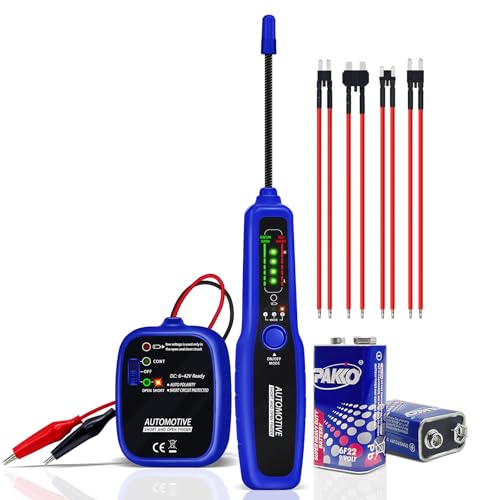
- Finds open circuits, short circuits, and continuity faults
- Uses sound plus LED indicators for clearer diagnosis
- Includes low-battery alerts on both transmitter and receiver
Best For: Fast circuit fault checks in 6-42V vehicle wiring
All-in-One Circuit Diagnosis – VDIAGTOOL V200 Pro
If you want an automotive wiring harness tester that does more than a basic continuity check, the VDIAGTOOL V200 Pro is built for broad circuit troubleshooting. It combines probing, wire tracing, voltage, resistance, diode, polarity, ground, relay, fuse, and trailer-light testing into one tool, which makes it practical for faster diagnosis on 12V/24V systems and many low-voltage vehicle setups.
Best For: Mechanics and DIY users who need an all-in-one tester for diagnosing shorts, opens, and wiring faults across many vehicle circuit types.
Pros:
- Covers a wide range of tests, including voltage, resistance, diode, continuity, polarity, ground, and wire tracing.
- Can help locate short circuits, open connections, broken wires, and current leaks.
- Supports component activation and signal circuit testing for items like lights, motors, wipers, fans, relays, and injectors.
- Includes overload protection plus long cord reach for working around larger vehicles.
Cons:
- More complex than a simple plug-in tester if you only need one job.
- Designed for low-voltage vehicle circuits, not general household electrical work.
Overall, this is a versatile choice if you want one automotive wiring harness tester that can handle probing, tracing, and circuit activation without switching tools constantly. The extra functionality is useful, but it is best suited to users comfortable with a more feature-rich diagnostic tool.
Trailer Connector Checker – Oyviny 4/7 Pin Trailer Tester
This automotive wiring harness tester is aimed at trailer connections rather than full vehicle harness diagnostics. The Oyviny unit combines 4-pin flat and 7-pin RV blade testing in one simple plug-in design, letting you verify trailer lighting and power functions quickly without batteries or extra wiring.
Best For: Truck, trailer, RV, and boat owners who need a fast way to check 4-pin and 7-pin trailer wiring.
Pros:
- Tests both 4-pin flat and 7-pin RV blade connectors in one tool.
- Double-sided LED indicators make the wiring status easier to read.
- Checks six trailer functions, including taillights, brakes, reverse lights, turn signals, electric brakes, and 12V auxiliary power.
- No batteries or wiring needed; just plug it in and read the LEDs.
Cons:
- Not suitable for vehicles with a lamp-out sensor.
- Focused on trailer connectors, so it is not a general-purpose harness diagnostic tool.
For trailer owners, this is a straightforward, low-fuss tester that makes it easy to confirm whether the connector wiring is doing what it should. Its simplicity is the main advantage, but the limited scope means it is best for trailer-specific checks.
Hidden Wire Locator – EM415Pro Wire Tracer
The EM415Pro is a practical automotive wiring harness tester for tracking hidden wires and finding circuit faults without cutting insulation. It uses transmitter signal and audible receiver feedback to help locate open and short circuits, and the 7-inch flexible probe makes it easier to work in tight spaces like dashboards, fuse boxes, connectors, and wire harnesses.
Best For: Technicians and DIYers who need to trace hidden low-voltage wiring and diagnose open or short circuits.
Pros:
- Helps locate open wires, short circuits, and circuit paths with signal and audible feedback.
- Designed to trace hidden wiring behind panels, under carpets, and through harnesses.
- Works on 6-42V DC automotive and low-voltage circuit diagnostics.
- Flexible 7-inch probe improves access in cramped areas.
Cons:
- Battery-powered setup adds another component to keep charged or supplied.
- Built for low-voltage DC systems, not higher-voltage applications.
If your main job is finding where a wire runs or pinpointing a circuit break, this tester is a solid fit. It is especially useful when you need a non-contact approach that avoids damaging insulation while still giving you tracing feedback.
Terminal Pull Test Bench – Wire Terminal Pull Force Tester
This is not a handheld automotive wiring harness tester for field troubleshooting; it is a portable force-testing machine for terminal pull-out and wire-harness quality control. With 1000N load capacity, 0.5% accuracy, and multi-unit output, it is suited to controlled testing where consistent measurement matters more than quick diagnostics.
Best For: Labs, factories, and QA teams checking terminal retention strength on wiring harnesses and related components.
Pros:
- High-precision force measurement with 0.5% accuracy and 0.1N resolution.
- 1000N load capacity supports terminal pull-out and strength testing.
- Compact, portable design works well on a tabletop in lab or factory settings.
- Supports Kg, N, and Ib units and includes data output for computer analysis.
Cons:
- Not a diagnostic tool for finding electrical faults in a vehicle.
- Best suited to bench testing rather than roadside or garage troubleshooting.
For wiring-harness quality control, this unit serves a very different role than a circuit probe or tracer. It is the right pick when your priority is verifying terminal pull strength and documenting results rather than testing live circuits.
Digital Voltage Check – WINAMOO 3-48V LED Test Light
If you want an automotive wiring harness tester that focuses on quick voltage checks, this WINAMOO test light is built for straightforward troubleshooting across 3V-48V systems. The digital LED display gives a clear readout, while the polarity indicator helps you confirm positive or negative circuits fast when diagnosing vehicle electrical issues.
Best For: Quick voltage and polarity checks on cars, trucks, SUVs, and boats.
Pros:
- LED digital display with 0.1V resolution for clear readings
- Dual-color polarity indication: red for positive, green for negative
- 96-inch spring wire and large alligator clip for easier reach and one-handed use
- Sharp stainless probe helps access tight or hard-to-reach spots
Cons:
- Designed for voltage and circuit checks, not full wire tracing
- Maximum range tops out at 48V DC
This is a practical pick if you need a durable test pen for fast circuit verification and battery-related diagnostics. It trades advanced tracing features for simple, readable results and broad vehicle compatibility.
Open & Short Locator – VSTM DC 6-42V Wire Tracer
For a more advanced automotive wiring harness tester, the VSTM wire tracer is aimed at finding open circuits, short circuits, broken wires, and continuity problems without damaging insulation. Its transmitter and receiver combination uses sound and light signals, making it better suited to fault-finding than a basic probe tester.
Best For: Locating opens, shorts, and broken wires in vehicle and general electrical circuits.
Pros:
- Transmitter and receiver work together for wire tracing and fault location
- Sound and LED signals make results easy to follow
- Adjustable sensitivity helps pinpoint open and short circuit locations
- Dedicated continuity mode simplifies wire integrity checks
Cons:
- Battery powered, so runtime depends on battery condition
- Operating range is limited to DC 6-42V systems
This tool is the strongest choice here when diagnosis means more than checking voltage. If you need to trace a wire path or isolate a fault location, it offers more diagnostic capability than a standard test light.
LED Circuit Pen – WINAMOO 6-24V Test Light
This WINAMOO model is a solid automotive wiring harness tester for low-voltage vehicle circuits where you want a simple probe-style check light. It uses an LED bulb whose brightness changes with the measured voltage, and the bidirectional setup supports testing on either side of the circuit.
Best For: Checking 6V-24V automotive circuits, fuse connections, and lighting circuits.
Pros:
- LED bulb provides visible circuit signals and includes a replacement bulb
- 135-inch PU spring wire adds reach and flexibility
- Large alligator clip supports easier one-handed operation
- Sharp stainless probe and insulating rubber tip help with access and safety
Cons:
- Limited to 6-24V DC applications
- Lacks digital voltage display found on more advanced testers
Use this when you want a durable, easy-to-handle tester for common vehicle checks rather than wire tracing. It is best suited to straightforward diagnostics on lights, sockets, and fuses.
Wire Tracing Kit – VDIAGTOOL V210 Open & Short Finder
If you need an automotive wiring harness tester that can help locate opens, shorts, and broken wires without damaging insulation, the VDIAGTOOL V210 is built for that kind of diagnostic work. It operates on 6-42V DC systems and uses transmitter/receiver tones plus LEDs to help you trace wiring faults in cars and motorcycles.
Best For: DIYers, technicians, and electricians tracing open or short circuits in low-voltage vehicle wiring.
Pros:
- Traces wires and helps locate breaker points, open connections, and current leaks
- Receiver includes an adjustable sensitivity knob and a flexible 7-inch probe
- LEDs and buzzer provide tone and visual feedback during diagnosis
- Includes 2-year warranty plus lifetime technical support
Cons:
- Only designed for 6-42V DC systems
- Signal strength and volume can vary with circuit conditions
- Requires 2 included 9V batteries to operate
Overall, this is a practical pick if your priority is fast circuit fault finding rather than general-purpose electrical testing. It is aimed at wire tracing and open/short diagnosis, with simple feedback that helps narrow down problem areas step by step.
Back Probe Test Set – Linkhood 31PCS Diagnostic Leads
For careful connector testing, this automotive wiring harness tester kit focuses on back probing and wire piercing rather than circuit tracing. The Linkhood 31-piece set gives you multiple probe styles, alligator clips, and banana-plug leads for checking automotive sensors, fuel injectors, and harness connectors without stripping cables.
Best For: Mechanics and DIY testers who need back probes and piercing leads for connector-level diagnostics.
Pros:
- Includes 15 back probe pins, 5 piercing probes, and 5 alligator clips
- Three probe angles help with different connector access points
- Piercing probes connect to 4mm banana plug leads for testing without stripping wires
- Useful for automotive diagnostics and broader shop or lab use
Cons:
- Not a wire tracer or open/short finder
- Back probes are rated for up to 30V, so it is not meant for higher-voltage work
- Best suited to connector access and signal testing, not fault locating by tone
This set makes sense if your work is centered on probing circuits at the connector or sensor level. It is less of a fault-finding tool and more of a practical test-lead kit for hands-on diagnostics.
Open & Short Finder – Automotive Wire Tracer Kit
If you want an automotive wiring harness tester that combines circuit tracing with clear status feedback, this wire tracer is built for 6-42V DC diagnostics. It can locate open connections, broken wires, and leaks, and it adds sound plus LED indicators to help in noisy work areas.
Best For: Technicians and DIY users who want a wire tracer with automatic open/short indication and continuity testing.
Pros:
- Automatically identifies open and short circuit status in SHORT/OPEN mode
- Sound and LED indication help when working in noisy environments
- Continuity mode checks whether a wire is in good condition
- Low-battery alerts on both transmitter and receiver improve reliability
Cons:
- Limited to vehicles with 6-42V DC electrical systems
- Requires included 9V batteries
- Best suited to tracing and continuity work, not general multimeter-style measurement
For users who want simple pass/fail feedback while hunting wiring faults, this kit offers a useful mix of tone, light, and automatic circuit status. It is a solid match for straightforward automotive diagnostics where quick identification matters.
How We Picked the Best Automotive Wiring Harness Tester Options
We prioritized tools that help diagnose common electrical problems in real-world automotive use, including circuit tracing, open-and-short finding, voltage checking, polarity indication, and probe usefulness. We also looked for clear displays, usable lead lengths, broad voltage coverage, and accessories that make testing easier under the hood, at the trailer connector, or inside the cabin.
Quick Comparison: Which Type Fits Your Job?
If you mainly need to locate broken wires or intermittent faults, a wire tracer or circuit breaker finder is usually the best match. If you want general electrical checks, a test light or circuit probe can be more versatile. For trailer lighting issues, a dedicated trailer plug tester is often the fastest way to isolate connector-side problems. If you frequently back-probe connectors, a probe kit and quality leads can be just as important as the tester itself.
Key Buying Factors for an Automotive Wiring Harness Tester
Voltage Range
Make sure the tester supports the systems you work on. Most passenger vehicles are 12V, but many tools in this category also cover 24V and wider DC ranges for mixed-use shops and trailers.
Fault-Finding Method
Some tools are designed to trace wires and identify opens or shorts, while others confirm power, ground, and continuity. Choose the method that matches your most common diagnostic tasks.
Readability and Feedback
LED indicators, digital voltage displays, polarity alerts, and audible signals can speed diagnosis, especially in low-light areas or when you are working alone.
Lead Length and Probe Access
Long cables, alligator clips, back-probe pins, and piercing probes improve reach and make it easier to test tight harnesses without damaging insulation.
Build Quality and Safety
Look for insulated grips, sturdy clips, and accessories that hold up to repeated shop use. A rugged Automotive Wiring Harness Tester should feel secure in hand and consistent in its readings.
Who Should Buy Which Automotive Wiring Harness Tester?
DIY owners who need occasional troubleshooting may prefer a simple circuit tester or test light. Mobile technicians and shop users will usually get more value from a wire tracer or open-and-short finder with stronger diagnostic feedback. Trailer owners should lean toward plug-specific testers, while advanced users may want a probe kit and tracer combination for maximum flexibility across harness repair jobs.
The best choice is the one that matches your typical faults, connector types, and working environment. For most users, a versatile Automotive Wiring Harness Tester with clear indicators and enough accessories will save the most time.