A good trailer wiring circuit tester saves time, prevents guesswork, and helps you spot wiring faults before they become roadside problems. Whether you tow with a 4-way flat or 7-pin RV setup, the right tester can make troubleshooting much faster.
Below, we focus on practical options for drivers, RV owners, and boat-trailer users who want a simple way to check trailer light circuits, confirm pin function, and narrow down wiring issues.
Best 10 Trailer Wiring Circuit Tester Picks for 2026
4-Way Flat Plug-and-Play Tester
True Mods Trailer Wiring Check
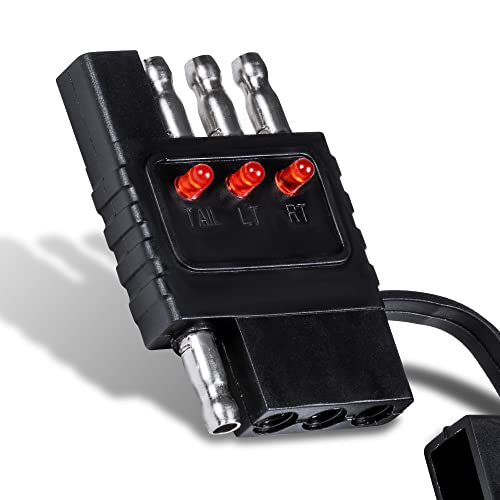
- Inline testing helps split trailer vs. vehicle faults
- LEDs are easy to read during basic light checks
- Compact, durable design stores easily in a vehicle
Best For: 4-pin flat trailer light troubleshooting
7-Way RV Socket Verifier

- Checks taillights, brakes, reverse, signals, and aux power
- LEDs provide quick visual confirmation of each circuit
- Ergonomic hooks make plug-in and removal easier
Best For: 7-way RV vehicle socket checks
Dual-Format LED Tester
Oyviny 4/7 Pin Trailer Checker

- Supports both 4-pin flat and 7-pin RV blade connectors
- Double-sided LEDs make circuit checks easier to read
- Tests six functions without batteries or wiring
Best For: Users who need one tester for both common trailer plug types
7-Way Blade Light Checker

- Works with standard 7-way blade trailer outlets
- Six labeled LEDs help identify working circuits quickly
- ABS body and brass pins are built for durability
Best For: Quick visual diagnosis of 7-way trailer socket circuits
Compact 4-Way Tester
Oyviny 4-Way Flat Trailer Wiring Tester

- Tests 4-pin flat trailer wiring and light functions
- Bright LEDs help pinpoint wiring problems fast
- Double-end design also acts as a standard connector
Best For: Basic 4-way trailer wiring checks and quick troubleshooting
Multi-Connector 3-in-1 Tester
Oyviny 3-in-1 Trailer Plug Tester

- Tests 4-pin, 5-pin, and 7-way trailer connectors
- Double-sided LEDs make readings easier to see
- No batteries or wiring needed for use
Best For: Mixed connector setups that need one versatile tester
7-Pin Quick Check
NeaLia 7 Pin Trailer Plug Tester

- Quick 30-second test for 7-way signals
- 180° rotatable head for flexible socket orientation
- Compact, plug-and-play design for standard 7-pin systems
Best For: Drivers who want a fast 7-pin trailer wiring check
Dual-Connector LED Tester
Oyviny 7 Way Blade & 4 Pin Tester

- Tests both 4-pin flat and 7-way blade connectors
- Bright LED indicators for easy circuit checking
- No batteries needed; durable ABS with copper terminals
Best For: Users who need one tester for both 4-pin and 7-way trailer sockets
4-Pin Flat Troubleshooter
4-Way Flat Trailer Wiring Tester

- Built for standard 4-pin flat trailer harnesses
- LED indicators help identify circuit faults
- Compact ABS design with copper terminals and dust cover
Best For: Owners who only need to troubleshoot 4-pin flat trailer lighting
4-Way Flat Plug-and-Play Tester – True Mods Trailer Wiring Check
If you need a simple trailer wiring circuit tester for a 4-pin setup, this True Mods unit keeps the process straightforward. Just plug it inline between the tow vehicle and trailer, turn on the lights, and use the LEDs to narrow down whether the issue is on the vehicle side or trailer side.
Best For: Quick, no-tools testing of 4-way flat trailer light connections.
Pros:
- Inline design helps isolate wiring problems fast
- No tools needed for plug-and-play use
- Easy-to-read LED indicators simplify checks
- Compact body is easy to store in a glove box or tool box
Cons:
- Only for 4-pin flat trailer connectors
- Not meant for 7-way RV blade systems
- No advanced diagnostic features beyond basic continuity-style testing
For basic trailer light troubleshooting, this tester focuses on speed and simplicity. Its weather- and corrosion-resistant construction adds practical durability for regular use.
7-Way RV Socket Verifier – CURT Vehicle Harness Tester
This CURT trailer wiring circuit tester is built for 7-pin RV blade sockets and gives you a fast way to confirm key towing functions. Plug it into the vehicle socket, activate each circuit from the driver’s seat, and use the LEDs to verify taillights, brake lights, reverse lights, turn signals, electric trailer brakes, and auxiliary power.
Best For: Checking a vehicle’s 7-way RV wiring before connecting a trailer.
Pros:
- Tests multiple 7-way functions, including brakes and auxiliary power
- LED indicators make pass/fail checks easy to see
- Ergonomic hooks help with plugging in and removing
- Durable plastic housing is made to resist rust and corrosion
Cons:
- Works only with 7-pin RV blade style sockets
- Requires a helper or driver input to activate circuits
- No dual 4-pin compatibility
If you want a purpose-built tester for a 7-way setup, this model keeps diagnostics simple and focused. It’s a practical pick for quick towing-harness checks without extra complexity.
Dual-Format LED Tester – Oyviny 4/7 Pin Trailer Checker
For shoppers who need one trailer wiring circuit tester for both common connector styles, this Oyviny model combines 4-pin flat and 7-pin RV blade testing in a single tool. The double-sided LEDs are especially useful when you want an easier read while checking trailer light functions and confirming a repair.
Best For: Testing both 4-pin and 7-pin trailer connectors with one tool.
Pros:
- 2-in-1 design works with 4-pin flat and 7-pin blade connectors
- Double-sided LEDs are easier to read than one-sided layouts
- Tests six light functions, including brakes and auxiliary power
- ABS housing and tin-plated copper terminals support durability and conductivity
Cons:
- Not suitable for vehicles with a lamp-out sensor
- Only a 30-day manufacturer warranty
- Still limited to the listed trailer connector formats
This is a solid choice if you service different trailers and want a single tester for both 4-way and 7-way setups. The readable LED layout and simple plug-in design make it convenient for quick troubleshooting.
7-Way Blade Light Checker – Red LED Trailer Socket Tester
This trailer wiring circuit tester is aimed at standard 7-way blade outlets and gives you a simple plug-and-play way to diagnose socket problems. With six labeled LED indicators, it helps you quickly see which circuits are working and which ones need attention.
Best For: Fast visual diagnosis of standard 7-way trailer outlets.
Pros:
- Compatible with standard 7-way blade trailer outlets
- Six labeled LED indicators simplify troubleshooting
- High-quality ABS plastic and copper construction supports durability
- Brass pins help maintain a stable electrical connection
Cons:
- Only designed for 7-way blade outlets
- Battery powered, so it is not a purely passive inline tester
- Does not cover 4-pin trailer connectors
For a straightforward 7-pin check, this model emphasizes clear indicators and solid construction. It’s a practical option if you want an easy visual read on trailer socket circuit problems.
Compact 4-Way Tester – Oyviny 4-Way Flat Trailer Wiring Tester
If you need a simple trailer wiring circuit tester for basic 4-pin flat setups, this Oyviny model makes troubleshooting straightforward. It checks turn signals and taillights, and its double-end design also lets it function as a standard 4-pin male and female connector when you need to test or connect wiring.
Best For: Drivers who want a small, easy-to-store tester for 4-way trailer wiring and quick light checks.
Pros:
- 4-pin tester helps confirm whether the problem is in the trailer wiring harness.
- Bright LED indicators make each electrical function easy to read.
- Double-end design works as both a male and female 4-pin connector.
- ABS plastic body and tin-plated copper terminals are built for durability and conductivity.
Cons:
- Only suited to 4-way flat trailer connections.
- No mention of support for 7-way RV blade systems.
This is a practical pick if your towing setup stays with standard 4-pin wiring and you want a compact tester you can keep in a toolbox or glove compartment. It focuses on the essentials without adding complexity.
Universal 7-Way Checker – NEW SUN Quick Connect 7-Pin Trailer Light Tester
This trailer wiring circuit tester is built for 7-way setups and gives you a fast way to verify trailer light functions before you tow. It uses plug-and-play operation, with LED indicators that help you check taillights, brake controller output, reverse circuit, turn signals, and 12-volt power feed.
Best For: Owners of trucks, RVs, campers, and other tow vehicles with compatible 7-way trailer plugs.
Pros:
- Tests six trailer light functions with one device.
- Plug-and-play setup needs no tools or batteries.
- Durable nylon body and copper terminals are designed to resist wear, water, heat, and corrosion.
- Compact size makes it easy to keep in a glove compartment or toolbox.
Cons:
- Only fits compatible 7-way trailer plugs.
- Bulkier than the smallest flat-pin testers.
If you regularly tow with a 7-way connector, this is a straightforward circuit-checking tool that covers the most important trailer lighting and power outputs. It keeps the process simple while still offering broad compatibility across common tow setups.
Multi-Connector 3-in-1 Tester – Oyviny 3-in-1 Trailer Plug Tester
For buyers who want one trailer wiring circuit tester that covers more than a single connector type, this Oyviny model combines 4-pin flat, 5-pin flat, and 7-way RV blade testing in one tool. It uses double-sided LED indicators on the 5-pin and 7-pin sides, making the readings easier to see while you troubleshoot or confirm a repair.
Best For: People who work with mixed trailer connector types and want one compact tester for multiple plug styles.
Pros:
- 3-in-1 design tests 4-pin flat, 5-pin flat, and 7-way trailer connectors.
- Double-sided LED indicators improve visibility on the 5-pin and 7-pin sides.
- Checks six functions, including taillights, brake lights, reverse lights, turn signals, electric trailer brakes, and 12V auxiliary power.
- Simple to use with no batteries or wiring needed.
Cons:
- Not suitable for vehicles with lamp-out sensors.
- Compatibility limitations may exclude some newer vehicles.
This is the most flexible option in the group if your towing needs vary between flat and RV blade connectors. Just make sure your vehicle does not use a lamp-out sensor before choosing it.
7-Pin Quick Check – NeaLia 7 Pin Trailer Plug Tester
If you need a trailer wiring circuit tester for standard 7-way setups, this NeaLia plug-in tool is built for fast, no-fuss checks. It covers the key trailer light and power functions in about 30 seconds, making it a practical option for routine troubleshooting on trailers, RVs, trucks, pickups, and campers.
Best For: Quick checks on standard 7-pin trailer connections when you want a compact, plug-and-play tester.
Pros:
- Tests 7 signals, including tail marker, brake, backup, left turn, right turn, stop, and 12V auxiliary power
- Plug-and-play design with a standard 7-way connector
- 180° rotatable head helps with upward or downward trailer sockets
- Compact size makes it easy to store in a cab, toolbox, or glove compartment
Cons:
- Designed for traditional analog systems, so compatibility may be limited with digital systems or advanced ECUs
- Only works with standard 7-pin trailer connectors
Overall, this is a straightforward trailer wiring circuit tester for users who want a fast visual check and simple storage-friendly design. Its main strengths are convenience and broad 7-way signal coverage, as long as your vehicle uses a compatible analog setup.
Dual-Connector LED Tester – Oyviny 7 Way Blade & 4 Pin Tester
This trailer wiring circuit tester is a handy choice if you need one tool for both 4-pin and 7-way trailer sockets. The Oyviny unit uses bright LED indicators to help you quickly confirm multiple lighting and power functions without batteries or extra wiring.
Best For: Testing both 4-pin and 7-way trailer connections with clear LED status lights.
Pros:
- 2-in-1 design supports both 4-pin and 7-way blade connectors
- Tests 6 functions, including taillights, brake lights, reverse lights, turn signals, electric brakes, and 12V auxiliary power
- LED indicators make it easier to spot which circuit has a problem
- No batteries or wiring needed, with durable ABS and tin-plated copper terminals
Cons:
- Not compatible with LED lighting systems
- May not work with vehicles that have lamp-out sensors
- Testing orientation can be upside down on some 2017-newer Ford/GMC/Chevy models
For shoppers comparing a trailer wiring circuit tester with broader connector coverage, this model stands out for its dual-format convenience and easy-to-read LEDs. Just be sure your vehicle and lighting setup match the stated compatibility limits.
4-Pin Flat Troubleshooter – 4-Way Flat Trailer Wiring Tester
If your trailer setup uses a standard 4-pin flat connection, this trailer wiring circuit tester is designed for straightforward troubleshooting. It plugs in directly to help you verify whether taillights and turn signals are operating normally, with LED indicators that make fault-finding simpler.
Best For: Diagnosing 4-pin flat trailer lighting issues quickly and with minimal guesswork.
Pros:
- Purpose-built for standard 4-pin flat trailer wiring harnesses
- Plug-and-play operation with direct connector testing
- LED indicators use different colors to help identify faulty circuits
- Compact ABS body with copper terminals and a dust cover for added protection
Cons:
- Only supports 4-pin flat trailer connections
- Not intended for 7-way trailer sockets
This is a practical pick if you only need a simple 4-pin trailer wiring circuit tester for lights and turn signals. It keeps troubleshooting focused and portable, especially for users who want a dedicated flat-connector tool.
How We Picked These Trailer Wiring Circuit Tester Options
We prioritized testers that match the most common trailer connections, including 4-pin flat, 5-pin, 7-pin RV blade, and round-style plugs. We also looked for clear LED indicators, dual-sided designs, easy plug-in use, and compatibility with both trailer-side and vehicle-side testing.
Because this is a tool roundup, we favored models that are straightforward to use at the hitch, durable enough for repeated towing checks, and useful for quick fault isolation without complicated setup.
Quick Comparison
For simple 4-way flat trailers, compact double-end testers are usually the easiest choice. If you tow RVs, campers, or utility trailers with more complex lighting and brake circuits, a 7-pin tester is the better fit. Multi-connector models are best if you work on different trailers or want one tool for several pin configurations.
Key Buying Factors for a Trailer Wiring Circuit Tester
Connector Type
Match the tester to your trailer plug: 4-pin flat for basic lighting, 5-pin for brakes on some setups, and 7-pin for RV and brake-controller systems. A mismatch means the tool won’t help much, no matter how well it’s built.
Indicator Visibility
Bright LEDs are important in daylight and roadside conditions. Double-sided indicators can make it easier to verify signal presence without constantly repositioning the tester.
Direction of Testing
Some testers are designed for the trailer side, some for the vehicle socket, and some handle both. If you troubleshoot both tow vehicles and trailers, choose a model that supports both ends or multiple connector styles.
Build and Contact Quality
Look for solid terminals, tight-fitting plugs, and corrosion-resistant materials. Poor contact quality can create false readings and waste time during diagnosis.
Ease of Use
The best Trailer Wiring Circuit Tester should let you plug in, read the lights, and move on quickly. Simple labeling and intuitive LED patterns matter more than extra features for most buyers.
Who Should Buy Which Trailer Wiring Circuit Tester?
Choose a basic 4-pin tester if you tow small trailers and want the simplest possible solution. Go with a 7-pin RV tester if you handle campers, enclosed trailers, or brake-equipped setups. If you manage multiple trailer types, a 3-in-1 or multi-function tester offers the most flexibility and usually the best long-term value.
For occasional use, prioritize ease and compatibility. For frequent towing or repair work, prioritize durability, clear indicators, and broad connector support so you can diagnose problems faster and with less trial and error.