The best rolling shop stools for professional mechanics make low, repetitive garage tasks more comfortable without slowing you down. A stable seat, smooth casters, useful storage, and the right working height can reduce strain during long repair sessions.
We compared 10 popular mechanic stools across capacity, adjustability, mobility, construction, and convenience features to help you choose a dependable seat for your shop, garage, or workshop.
Best 10 Rolling Shop Stools for Professional Mechanics Picks for 2026
Heavy-Duty Storage Pick
VEVOR 300-LB Rolling Mechanic Stool

- Three trays plus a pull-out drawer
- Rubber casters with two brakes
- Low 15.4-inch padded seat
Best For: Low-profile automotive work with tools close at hand
Adjustable Value Pick
MaxWorks Pneumatic Roller Seat

- 15- to 20-inch pneumatic height range
- Five non-marring swivel casters
- Built-in 15.25-inch tool tray
Best For: Flexible-height garage and workshop tasks
Balanced Pneumatic Pick
WEN 73012T Rolling Mechanic Stool

- 15- to 20-inch lever adjustment
- Five swiveling casters for mobility
- Vinyl padding and 300-pound capacity
Best For: Everyday adjustable garage and workshop use
Best Adjustable Comfort
Heavy-Duty Rolling Stool with Backrest
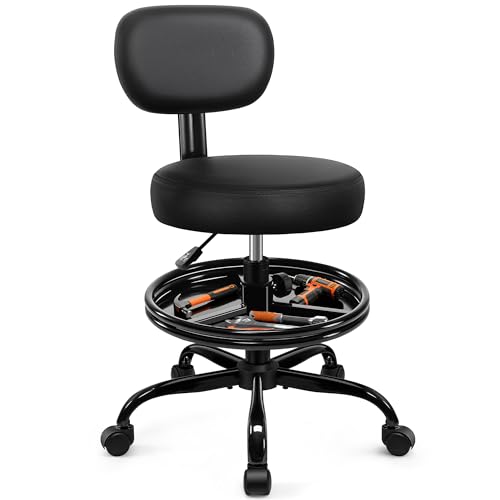
- 17.32–23.5-inch pneumatic height adjustment
- Backrest, footrest, and three storage trays
- Steel frame rated for up to 340 pounds
Best For: Extended repair sessions requiring ergonomic support and flexible positioning
Best Adjustable Pneumatic Seat
DNA Motoring Rolling Mechanic Stool

- Pneumatic height adjustment from 40–54 cm
- Four swivel casters for mobile work
- Removable four-compartment tool chassis
Best For: Mechanics needing adjustable seating with compact tool storage
Best Simple Tool-Tray Design
MaxWorks Mechanics Roller Seat

- Fully padded rolling seat
- Three-section tray for tool organization
- Heavy-duty tubular-steel frame
Best For: Garage work requiring a stable seat and accessible tools
Best Comfort and Capacity
Adjustable Rolling Shop Stool with Backrest
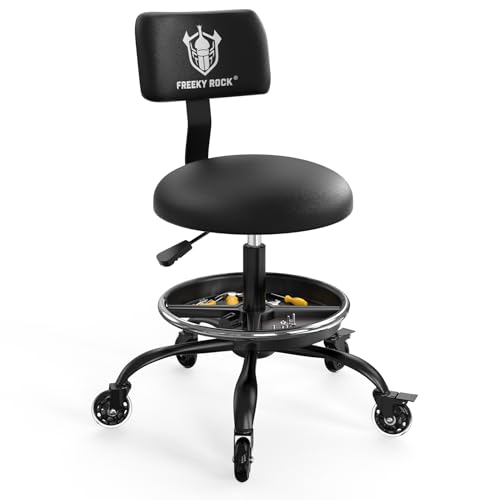
- Pneumatic height range of 18.7–25.59 inches
- Memory-foam seat, backrest, and footrest
- 330-pound capacity with locking casters
Best For: Extended seated work requiring support and controlled mobility
Heavy-Duty Storage Pick – VEVOR 300-LB Rolling Mechanic Stool
For professional mechanics who need rolling shop stools for professional mechanics with built-in organization, this VEVOR model combines a low 15.4-inch seat with three tool-storage areas. Its rubber casters, padded seat, and 300-pound capacity make it practical for automotive repairs, tire work, and detailing.
Best For: Mechanics who want a low-profile rolling seat with generous onboard tool storage.
Pros:
- Three storage trays, including a pull-out tray, keep tools within reach.
- Four-inch rubber casters include two brake casters and support smooth 360-degree movement.
- Thick curved cushion and steel base support comfortable, heavy-duty use.
- Low-profile design helps with access around vehicles and tight work areas.
Cons:
- The fixed 15.4-inch seat height is less versatile than pneumatic models.
- The plastic seat may provide less premium durability than a fully metal design.
This is a strong choice when storage and low vehicle access matter more than height adjustment. The brakes add positioning control, while the tray layout can reduce trips back to a toolbox.
Adjustable Value Pick – MaxWorks Pneumatic Roller Seat
MaxWorks 80771 Pneumatic Roller Seat/Creeper with Adjustable Height - 300 lb Capacity
Check Price On AmazonThe MaxWorks 80771 is a practical option among rolling shop stools for professional mechanics when adjustable working height is important. Its pneumatic lever moves the seat from 15 to 20 inches, while five non-marring swivel casters and an integrated tool tray support mobile garage work.
Best For: Mechanics who need straightforward height adjustment and a compact tool tray.
Pros:
- Pneumatic side-lever adjustment provides a 15- to 20-inch height range.
- Five 2.5-inch swivel casters roll easily under load.
- Thick cushioned seat and built-in 15.25-inch tool tray add comfort and convenience.
- Supports up to 300 pounds.
Cons:
- The notes do not mention brakes for locking the stool in place.
- Its tool storage is limited to the integrated tray.
Choose this model if you want a simple rolling seat that can adapt to different work heights without adding a large storage structure. It suits garages, workshops, and other general workspaces.
High-Seat Comfort Pick – BILITOOLS 330-LB Rolling Shop Stool
For bench work, detailing, and repairs performed at a higher working level, the BILITOOLS stool stands out among rolling shop stools for professional mechanics. It adjusts from 21.5 to 29.5 inches, adds a padded backrest and footrest, and supports up to 330 pounds on a powder-coated steel frame.
Best For: Mechanics and detailers who prefer a taller, supportive seat for benches and extended tasks.
Pros:
- One-hand pneumatic lever adjusts the seat from 21.5 to 29.5 inches.
- Oversized 16-inch padded seat swivels 360 degrees.
- Four-inch backrest and steel foot ring add support during longer jobs.
- Bottom shelf provides space for sockets, wrenches, and parts.
Cons:
- Its taller profile is less suited to low-access vehicle work than a low mechanic seat.
- The 21-pound weight is heavier than the compact roller-seat options listed.
- The notes mention casters but do not specify their size or whether they lock.
This is the most chair-like option in the group, with a high adjustment range and back support that can reduce the need to stand repeatedly. Its shelf is useful for essentials, though it is not as storage-focused as a drawer-equipped stool.
Balanced Pneumatic Pick – WEN 73012T Rolling Mechanic Stool
The WEN 73012T offers a balanced combination of mobility, cushioning, adjustability, and basic tool access for professional mechanics. Its pneumatic seat adjusts from 15 to 20 inches, while five swiveling casters support movement around a garage or workshop.
Best For: Mechanics seeking a compact, height-adjustable stool for everyday garage work.
Pros:
- Lever-controlled pneumatic adjustment covers 15 to 20 inches.
- Five 2.5-inch swiveling casters provide omnidirectional movement.
- Thick vinyl-protected padding is designed for comfort and absorption.
- Steel-frame construction supports up to 300 pounds of evenly distributed weight.
Cons:
- The onboard storage is described generally, without tray or drawer dimensions.
- The notes state that assembly instructions are not included.
- No caster brakes are specified.
This WEN is a sensible middle ground for mobile repair work: more adaptable than a fixed-height stool and simpler than a storage-heavy mechanic seat. It is particularly appealing when a modest footprint and smooth repositioning are priorities.
Best Adjustable Comfort – Heavy-Duty Rolling Stool with Backrest
For professional mechanics who need flexible positioning, this rolling shop stool combines pneumatic height adjustment, lumbar support, swivel movement, and built-in tool storage. It is a strong option among rolling shop stools for professional mechanics who spend extended periods working around a vehicle or bench.
Best For: Long repair sessions, varied work heights, and mechanics who want back support plus organized tool access.
Pros:
- Adjusts from 17.32 to 23.5 inches, with a separately adjustable storage tray.
- Padded seat and contoured backrest provide lumbar support for extended tasks.
- Five casters, 360-degree swivel, adjustable footrest, and three trays support efficient movement.
- Heavy-gauge steel frame supports up to 340 pounds and includes a five-year warranty.
Cons:
- Its backrest and storage features make it less compact than a basic low-profile creeper seat.
- Assembly is required, including attaching the seat and casters.
This is the most feature-rich choice of the three for mechanics who prioritize ergonomic support and organization. Choose it when adjustability and a higher working position matter more than a minimalist footprint.
Best Low-Profile Value – BIG RED Rolling Creeper Seat
The BIG RED mechanic stool is a straightforward low-profile option for professionals who want mobile seating and quick access to frequently used tools. Among rolling shop stools for professional mechanics, its compact 15-inch height suits work close to cars, trucks, and other low areas.
Best For: Low-position automotive repairs, driveway work, and mechanics who prefer a simple, portable rolling seat.
Pros:
- Reinforced alloy-steel frame supports up to 250 pounds and uses an anti-tilt design.
- 2.5-inch ball-bearing casters roll across concrete, epoxy, and gravel.
- Three-zone tray keeps wrenches, screws, fluids, and other small items within reach.
- Fully padded polyurethane seat is designed for comfort and wipes clean easily.
Cons:
- The fixed 15-inch height offers less positioning flexibility than adjustable models.
- It has no backrest or adjustable footrest for added support during long sessions.
This stool favors simplicity, portability, and low-level access over ergonomic customization. It is a practical pick for mechanics who mainly work near the floor and want a compact seat with useful under-seat storage.
Best for Controlled Positioning – Adjustable Mechanic Stool with Backrest
This adjustable garage stool is designed for mechanics who want a supportive seat, elevated working range, and controlled rolling. Its 20- to 26.1-inch height range, braking casters, footring, and removable trays make it a versatile choice among rolling shop stools for professional mechanics.
Best For: Bench and auto-repair work where lumbar support, higher seating, and occasional wheel braking are useful.
Pros:
- Seat height adjusts from 20 to 26.1 inches and supports up to 330 pounds.
- Thick PU-covered foam seat and padded backrest provide support and are easy to clean.
- Two casters include brakes to help prevent unexpected movement during precise tasks.
- Adjustable footring and three removable, partitioned trays improve comfort and organization.
Cons:
- It carries a six-month manufacturer warranty, shorter than the five-year warranty listed for the first stool.
- Assembly is required, although the supplied instructions and tools are intended to support setup.
- The listed indoor-use specification may limit suitability for outdoor work.
This model balances a relatively high seat range with back support and wheel control. It is a good fit for mechanics who alternate between work surfaces and want more stability than free-rolling casters provide.
Best Adjustable Pneumatic Seat – DNA Motoring Rolling Mechanic Stool
For professional mechanics comparing rolling shop stools for professional mechanics, this DNA Motoring model combines pneumatic height adjustment, a padded seat, four swivel casters, and removable tool storage. Its 300-pound total capacity makes it a practical choice for routine garage work.
Best For: Mechanics who want adjustable seating and nearby storage for small tools and parts.
Pros:
- Pneumatic seat adjusts from 40 to 54 cm.
- Four 2.5-inch swivel casters support smooth movement.
- Removable chassis provides four storage compartments.
- Supports up to 300 pounds, including tools.
Cons:
- The plastic cap must be removed before the pneumatic height function works.
- Storage is intended for smaller tools and parts.
This stool is a balanced option for mobile garage tasks, especially when adjustable height and compact onboard organization matter more than a backrest.
Best Simple Tool-Tray Design – MaxWorks Mechanics Roller Seat
The MaxWorks mechanics roller seat is a straightforward option for professional mechanics shopping for rolling shop stools for professional mechanics. It pairs a padded seat with a heavy-duty tubular-steel frame, segmented tool-tray storage, and smooth-rolling swivel casters.
Best For: Garage users who want a stable rolling seat with organized access to frequently used tools.
Pros:
- Fully padded seat adds cushioning during repair work.
- Large three-section tool tray keeps equipment accessible.
- Tubular-steel construction supports up to 250 pounds.
- Two-inch swivel casters provide smooth movement.
Cons:
- Its 250-pound capacity is lower than some heavy-duty alternatives.
- The supplied notes do not indicate height adjustment or a backrest.
Choose this model when you prefer a simple, durable roller seat with useful tool organization and do not need extra ergonomic features.
Best Comfort and Capacity – Adjustable Rolling Shop Stool with Backrest
This height-adjustable shop stool stands out among rolling shop stools for professional mechanics with its backrest, memory-foam cushion, footrest, wide steel base, and 330-pound capacity. It is designed for longer seated tasks where support and controlled mobility are priorities.
Best For: Professionals who want a supportive, height-adjustable stool for extended garage work.
Pros:
- Adjustable pneumatic height ranges from 18.7 to 25.59 inches.
- Thick memory-foam cushion, backrest, and adjustable footrest improve support.
- Wide 22.4-inch base supports up to 330 pounds.
- Five casters enable 360-degree movement, with two brakes for stability.
Cons:
- Its larger base may take more floor space than compact mechanic stools.
- The supplied details do not specify a manufacturer warranty.
This is the most comfort-focused choice in the group, with useful trays and wheel brakes for mechanics who alternate between moving around and working in one position.
How We Picked the Best Rolling Shop Stools for Professional Mechanics
We focused on features that matter during real garage work rather than appearance alone. Each stool was considered for weight capacity, seat comfort, rolling stability, height adjustment, storage access, and overall usefulness around vehicles or workbenches. Pneumatic models can provide faster height changes, while fixed-height or simpler designs may offer fewer parts to maintain.
We also looked for practical details such as padded seats, backrests, footrests, tool trays, swivel movement, and caster design. A stool that is easy to reposition but remains stable when reaching or turning is generally more useful than one that only offers a high weight rating.
Quick Comparison
The selected models cover several common configurations. VEVOR, BILITOOLS, WEN, and DNA Motoring offer options around the 300-pound capacity range, while the BILITOOLS model is rated up to 330 pounds. MaxWorks models include both a 300-pound pneumatic roller seat and a 250-pound heavy-duty creeper stool with multi-section tray storage. BIG RED and the backrest-equipped garage stools emphasize general shop seating, while adjustable pneumatic designs prioritize flexible working height.
Before buying, verify the exact listing for dimensions, included trays, caster type, minimum and maximum height, and weight rating, since product configurations can vary.
Key Buying Factors for Rolling Shop Stools for Professional Mechanics
Weight Capacity and Stability
Choose a capacity comfortably above the user’s weight, especially when leaning, reaching, or wearing heavy work clothing. A wide base, strong frame, and smooth-rolling casters are just as important as the advertised rating.
Height Adjustment
Pneumatic adjustment is helpful when moving between brakes, wheels, body panels, and workbenches. Compare the full height range rather than choosing based only on the maximum setting.
Seat Comfort and Back Support
A padded seat is valuable for extended jobs. A backrest can improve comfort during upright tasks, but it may make it harder to reach behind the body or slide close to a vehicle.
Storage and Mobility
Tool trays keep sockets, fasteners, and hand tools within reach, reducing trips across the shop. Look for tray sections that are deep enough to prevent tools from rolling out, and check that storage does not interfere with the stool’s movement.
Floor and Caster Compatibility
Hard casters typically roll well on smooth concrete or sealed garage floors. If your floor has cracks, debris, or transitions, prioritize stable wheels and avoid overloading the stool while moving.
Who Should Buy Which Rolling Shop Stools for Professional Mechanics?
Choose a pneumatic stool if you regularly switch between tasks at different heights and want quick adjustments. Select a model with a backrest for longer seated work where lumbar support is more important than maximum access around a vehicle. A tray-equipped stool is best for mechanics who want frequently used tools close at hand.
For heavier users or shared professional spaces, prioritize the highest suitable capacity with a robust base and reliable casters. For occasional home-garage projects, a simpler rolling stool may provide better value and fewer adjustment components. Whichever model you choose, stay within its rated capacity, keep the casters clear of cords and debris, and inspect hardware periodically for looseness or wear.