Choosing among soldering stations for circuit boards depends on more than maximum wattage. Temperature stability, tip selection, heat-up speed, ergonomics, and rework capability all affect how safely and consistently you can handle delicate components.
This roundup compares 10 stations across basic electronics repair, through-hole assembly, SMD work, and hot-air rework. Use the guide below to match the station’s features and accessories to your projects, workspace, and experience level.
Best 10 Soldering Stations for Circuit Boards Picks for 2026
Best All-Around Kit
YIHUA 926 III Digital Soldering Station
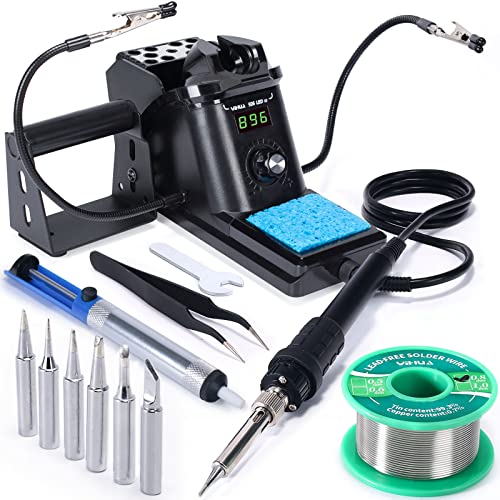
- 60W PID-controlled iron with 194°F–896°F range
- Digital display, calibration, and adjustable sleep mode
- 12-piece kit with helping hands and repair accessories
Best For: General PCB soldering and electronics repair
Best for Pedal-Controlled Production
Semi-Automatic PCB Soldering Machine
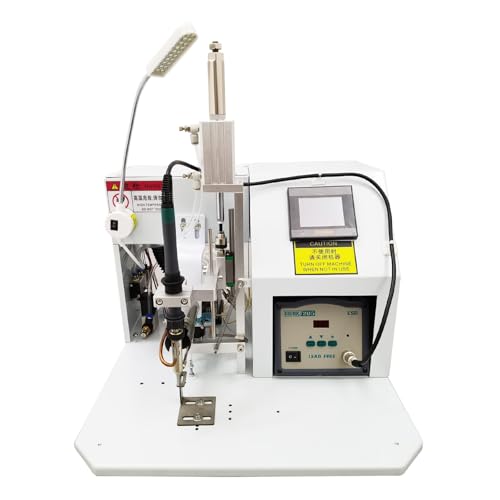
- Foot-pedal operation for hands-free workflow
- LCD control of tin output, speed, and mode
- Automatic tip cleaning and LED work lighting
Best For: Repetitive PCB assembly and small production lines
Best Compact 2-in-1 Rework Station
WEP 8786D-I SE Hot Air Soldering Station
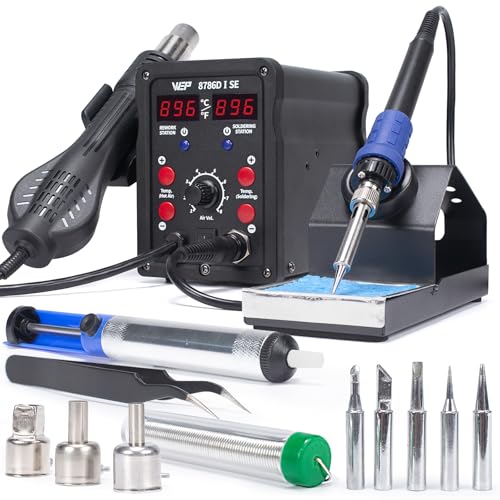
- Combines iron soldering and adjustable hot-air rework
- PID control with sleep and hot-air standby modes
- Includes tips, nozzles, solder wire, and desoldering tools
Best For: PCB repair and mixed soldering/rework tasks
Best High-Power Dual System
2-in-1 Hot Air Rework Station Kit

- Up to 700W power for rapid heating
- Independent iron and hot-air controls
- Includes five tips, three nozzles, and repair accessories
Best For: Phone, computer, and component rework
Best Compact Kit
WEP 927-IV 110W Soldering Station Kit
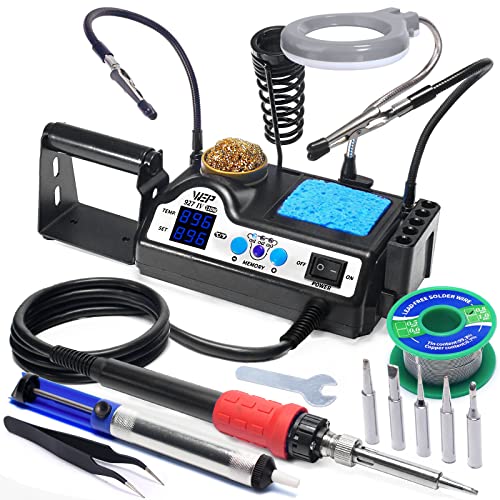
- 110W heating with 90°C–480°C adjustment
- Three presets and adjustable sleep mode
- Integrated magnifier, helping hands, and storage
Best For: Organized circuit-board soldering in a compact workspace
Best Entry-Level 2-in-1
8586D Hot Air and Soldering Station

- Independent soldering iron and hot-air functions
- Soldering range up to 932°F
- Includes five tips and three hot-air nozzles
Best For: Board repairs requiring conventional soldering and hot-air rework
Best Feature-Rich Rework Station
WEP 882D 2-in-1 Soldering and Hot-Air Station

- PID-controlled soldering and hot-air temperature
- Sleep, standby, shutdown, and calibration functions
- Includes two solder spools and multiple tips/nozzles
Best For: SMD rework and circuit-board repairs needing hot air
Best with Extra Features
YIHUA 926 III 60W Soldering Station
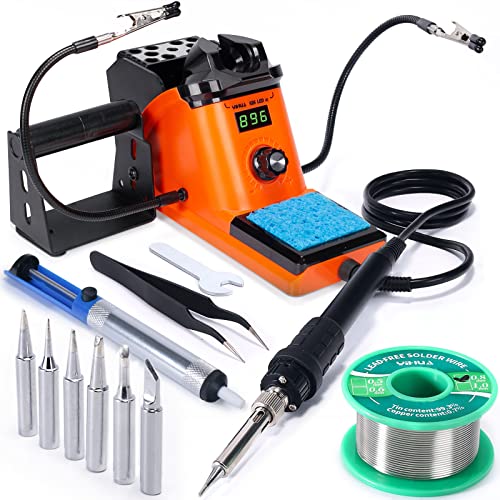
- 194°F–896°F range with PID control
- Helping hands and six tips included
- Compact holder and tip-storage design
Best For: Ready-to-use circuit-board work and general electronics projects
Best Compact Option
WEP 926LED V3 130W Soldering Station

- Integrated holder saves desk space
- 392°F–896°F digital temperature control
- Includes five tips and desoldering tools
Best For: Space-conscious hobbyists and beginner electronics users
Best Helping-Hand Setup
100W Digital Soldering Station Kit

- Two helping hands for component positioning
- 356°F–896°F adjustable temperature range
- 100W station with auto-sleep timer
Best For: Hands-free circuit-board repairs, crafts, and small electronics
Best All-Around Kit – YIHUA 926 III Digital Soldering Station
For hobbyists and electronics repairers comparing soldering stations for circuit boards, the YIHUA 926 III offers a practical single-iron setup with digital controls and useful accessories. Its 60W iron has adjustable temperature control, PID stabilization, and a compact footprint.
Best For: General PCB soldering, repairs, and beginners who want a ready-to-use accessory bundle.
Pros:
- Adjustable 194°F–896°F temperature range with PID stabilization.
- Digital display, °C/°F conversion, calibration support, and adjustable sleep mode.
- Includes two helping hands, six tips, lead-free solder, tweezers, solder sucker, and sponge.
- Integrated holder and rear tip-storage slots help conserve workspace.
Cons:
- Designed for 110–127V operation with a US-standard plug.
- Single-channel station does not provide hot-air rework.
This is a well-rounded choice when you need conventional soldering and desoldering tools in one compact package. The included helping hands and accessories add value for bench work, while auto-sleep and calibration support make regular use more convenient.
Best for Pedal-Controlled Production – Semi-Automatic PCB Soldering Machine
Among soldering stations for circuit boards, this semi-automatic machine is aimed at users who want foot-pedal operation and repeatable tin delivery. Its LCD controls adjust tin output, speed, and mode, while the temperature controller supports consistent soldering work.
Best For: Repetitive PCB assembly, connector work, and small production lines where hands-free control is useful.
Pros:
- Foot pedal helps reduce hand fatigue during repeated soldering tasks.
- LCD interface provides control over tin output, speed, and output mode.
- Automatic tip cleaning is designed to reduce pulling and support tip life.
- LED lighting can improve visibility in changing work environments.
Cons:
- At 37 pounds, it is substantially less portable than benchtop hobby stations.
- Its semi-automatic workflow may be excessive for occasional repairs.
- The supplied notes do not specify included soldering accessories or tips.
This machine makes the most sense when throughput and operator convenience matter more than portability. Its 110V, 160W design and pedal control suit structured work, but casual users may prefer a smaller conventional station.
Best Compact 2-in-1 Rework Station – WEP 8786D-I SE Hot Air Soldering Station
If you need soldering stations for circuit boards that can handle both component soldering and hot-air rework, the WEP 8786D-I SE combines both functions in one compact unit. Separate controls manage the iron and hot-air temperature, with adjustable airflow for rework tasks.
Best For: PCB repair, desoldering, and projects involving both through-hole or wire soldering and hot-air work.
Pros:
- Combines a soldering iron and hot-air rework station in one unit.
- Iron temperature adjusts from 392°F–896°F; hot air adjusts from 212°F–896°F.
- PID stabilization, 10-minute iron sleep mode, and hot-air standby mode support controlled operation.
- Includes five tips, three nozzles, solder wire, tweezers, and a desoldering pump.
Cons:
- Rated for 110–127V US operation and should not be connected to 220V.
- Hot-air operation adds capability but also increases setup complexity compared with a basic iron station.
This is a strong fit for repair benches where space and versatility are priorities. Independent displays and controls make the two functions easier to manage, while the included nozzles and desoldering tools let you begin rework without assembling a separate kit.
Best High-Power Dual System – 2-in-1 Hot Air Rework Station Kit
For demanding soldering stations for circuit boards, this 2-in-1 kit pairs an iron with a hot-air gun and uses independent switches for separate control. Its high-power design is intended for quick heating, while the hot-air channel provides a digital temperature readout and calibration features.
Best For: Cell phone, computer, component, and home-appliance repair where both iron and hot-air tools are needed.
Pros:
- Dual-system layout combines soldering and hot-air functions in one compact body.
- Up to 700W power is specified for rapid heating and efficient work.
- Iron range is 392°F–896°F; hot-air range is 212°F–896°F.
- Includes five tips, three nozzles, solder wire, desoldering pump, tweezers, and sponge.
Cons:
- The digital display shows hot-air temperature only, not the iron temperature.
- The product notes do not provide a complete voltage specification.
- Temperature calibration procedures are more involved than simple knob adjustment.
This station offers broad rework capability and a substantial power rating in a space-saving design. It is most appealing to users who can work with the display limitation and want independent iron and hot-air controls for varied repair jobs.
Best Compact Kit – WEP 927-IV 110W Soldering Station Kit
For circuit boards and general electronics work, the WEP 927-IV is a space-conscious soldering station with fast heating, preset temperature channels, and useful bench accessories built into the unit. Its 110W heating element supports a 90°C–480°C range, while the dual numerical display shows both set and actual temperature.
Best For: Electronics hobbyists who want an organized, all-in-one station for circuit-board soldering in a smaller workspace.
Pros:
- 110W heating element and adjustable 90°C–480°C temperature range.
- Three preset channels and adjustable sleep-mode timer simplify repeated work.
- Integrated helping hands, LED magnifier, tip storage, solder dispenser, and cleaner.
- Includes five extra tips, tweezers, desoldering pump, solder wire, and a one-year USA technical-support plan.
Cons:
- Designed for 110–127V USA power and should not be connected to a 220V outlet.
- The included model uses WEP #1400 soldering-iron tips.
The WEP 927-IV is a practical choice when workspace organization matters as much as temperature control. It is focused on conventional soldering rather than hot-air rework, but its integrated accessories make circuit-board tasks more convenient.
Best Entry-Level 2-in-1 – 8586D Hot Air and Soldering Station
The 8586D combines a temperature-controlled soldering iron with a hot-air rework station, making it a versatile option among soldering stations for circuit boards. Independent controls and LED displays let you operate either function separately or use both for different repair tasks.
Best For: Electronics users who need both standard soldering and hot-air rework for board-level repairs.
Pros:
- Two-in-one design includes independent soldering and hot-air stations.
- Soldering temperature adjusts from 356°F–932°F; hot air adjusts from 212°F–932°F.
- Hot-air airflow is adjustable from 10–99, with Celsius/Fahrenheit conversion.
- Automatic hot-air sleep mode helps reduce high-heat wear when the handle is set down.
Cons:
- The supplied notes do not specify a USA technical-support or warranty program.
- Its 5.9-inch height and 10.23-inch width may require more bench space than a basic iron station.
With separate displays, controls, and temperature ranges for each function, the 8586D offers broad rework capability in one unit. It is a sensible fit for users who expect to handle both through-hole soldering and hot-air board work.
Best Feature-Rich Rework Station – WEP 882D 2-in-1 Soldering and Hot-Air Station
The WEP 882D is a compact two-in-one platform for circuit-board soldering and SMD rework. It pairs a soldering iron with a variable-air hot-air station, using separate LED displays and PID-based temperature control for both functions.
Best For: Electronics rework users who want calibration, automatic shutdown, and a broad starter accessory kit.
Pros:
- Combines adjustable soldering temperatures of 392°F–896°F with hot air from 212°F–896°F.
- PID control, calibration, Celsius/Fahrenheit conversion, and variable airflow support more precise work.
- Sleep mode for the iron and standby mode for hot air can help reduce component and tool wear.
- Includes two solder-wire spools, five tips, three hot-air nozzles, tweezers, cleaner, and desoldering pump.
Cons:
- Rated for 110–127V USA power; it should not be connected to a 220V outlet.
- The supplied specifications list one channel, so it lacks the preset-channel feature of some stations.
The WEP 882D stands out when hot-air capability and adjustment features are more important than a simple soldering-only setup. Its included consumables and rework accessories also make it ready for a range of board-level projects.
Best with Extra Features – YIHUA 926 III 60W Soldering Station
For shoppers comparing soldering stations for circuit boards, the YIHUA 926 III combines adjustable temperature control, a compact footprint, and a broad accessory package. Its 194°F–896°F range, LED display, PID heat control, and calibration support make it adaptable for beginner projects and more demanding repairs.
Best For: Users who want a space-saving, ready-to-use station with helping hands and extensive accessories.
Pros:
- Wide 194°F–896°F temperature range with °C/°F conversion.
- PID control, calibration support, and adjustable sleep timer help maintain consistent operation.
- Includes two helping hands, six tips, lead-free solder, tweezers, and a solder sucker.
- Compact design integrates the soldering holder and tip-storage mesh.
Cons:
- Designed for 110–127V US power, so it is not intended for 220V outlets.
- The 60W rating may be less suitable for applications requiring higher power.
The YIHUA 926 III is a strong general-purpose choice when accessory value, precise controls, and an organized workbench matter more than maximum wattage.
Best Compact Option – WEP 926LED V3 130W Soldering Station
The WEP 926LED V3 is a compact pick among soldering stations for circuit boards, with a digital temperature display and a control range of 392°F–896°F. Its integrated holder, PID temperature compensation, and included essentials keep the setup tidy and approachable for hobby use.
Best For: Beginners and hobbyists with limited desk space who want a compact starter kit.
Pros:
- Integrated holder saves workbench space and provides heat-resistant storage.
- PID control helps keep the tip near the selected temperature.
- Includes five tips, solder wire, tweezers, a desoldering pump, and tip cleaner.
- Sleep mode lowers idling temperature after 10 minutes of inactivity.
Cons:
- Its temperature range starts at 392°F, offering less low-temperature flexibility than some alternatives.
- Rated for 110–127V US specifications and should not be connected to 220V.
This WEP station emphasizes a small footprint and straightforward controls, making it a sensible choice for circuit-board practice and routine electronics work in a crowded workspace.
Best Helping-Hand Setup – 100W Digital Soldering Station Kit
This 100W digital station is a practical option for soldering stations for circuit boards when positioning small parts is important. It combines a 356°F–896°F temperature range with two helping hands, adjustable auto-sleep timing, calibration, and a broad set of basic soldering accessories.
Best For: Circuit-board, phone, appliance, and craft projects that benefit from hands-free component positioning.
Pros:
- Fast-heating design with LED display and °C/°F conversion.
- Auto-sleep timer can be set from 0 to 600 seconds, with an on/off switch.
- Two helping hands support hands-free soldering and assembly.
- Includes five tips, solder wire, tip cleaner, tweezers, and a solder sucker.
Cons:
- The supplied temperature-stability detail is listed as 180°C, which is less specific than the other models’ stability specifications.
- The station has one channel, so it is intended for single-iron operation.
Choose this kit if included positioning support is a priority. Its helping hands and accessory bundle are especially useful for small circuit boards and repair tasks where both hands are needed.
How We Picked These Soldering Stations for Circuit Boards
We focused on features that have the greatest practical effect on circuit-board work: adjustable temperature control, usable power ratings, digital displays, included tips and nozzles, soldering-iron ergonomics, and support for lead-free solder. We also separated conventional soldering stations from 2-in-1 hot-air systems because they serve different repair needs.
Accessory bundles received consideration when they add genuine value, such as brass wool, solder suckers, helping hands, tweezers, spare tips, and magnifiers. However, included accessories should not outweigh stable heat delivery, safe operation, or replacement-part availability.
Quick Comparison
- Best for basic repairs: A conventional 60W to 100W digital station with multiple tips and helping hands.
- Best for SMD rework: A 2-in-1 station combining a soldering iron with adjustable hot air.
- Best for frequent production work: A higher-power station with preset channels, sleep mode, and fast heat recovery.
- Best for beginners: A complete kit with clear controls, a broad temperature range, and useful consumables.
- Best for specialized throughput: A semi-automatic or foot-pedal machine, provided its operating format suits your workspace.
Key Buying Factors for Soldering Stations for Circuit Boards
Temperature Control and Stability
Look for a clearly readable digital display and an adjustable range suitable for both standard solder and lead-free solder. Stable temperature regulation matters more than a high advertised maximum because excessive heat can lift pads, damage insulation, or harm sensitive components.
Power and Heat Recovery
Power ratings from 60W to 100W are generally suitable for many electronics tasks. Higher wattage can improve recovery when working with larger ground planes or connectors, but it does not automatically mean better precision. A well-controlled iron with appropriate tips is often more useful than raw power.
Iron, Tips, and Hot-Air Capability
Check whether replacement tips are easy to find and whether the included shapes match your work. Fine conical tips help with small joints, while chisel tips transfer heat more efficiently. For SMD removal and reflow, choose a 2-in-1 model with adjustable airflow, interchangeable nozzles, and a stable hot-air handle.
Safety and Workflow Features
Auto-sleep functions, insulated handles, grounded or ESD-conscious designs, secure stands, and accessible controls can make long repair sessions safer. Preset temperature channels are useful when switching frequently between different solder types or component sizes.
Who Should Buy Which Soldering Stations for Circuit Boards?
Occasional hobbyists should choose a straightforward digital iron station with a stand, spare tips, and basic desoldering tools. DIY repairers and makers will benefit from a higher-power station with helping hands, a broad temperature range, and fast recovery. SMD technicians should prioritize a 2-in-1 hot-air rework station with controllable airflow and several nozzle sizes. Production users should look for preset channels, sleep mode, durable accessories, and readily available replacement parts. A semi-automatic foot-pedal machine makes the most sense only when its workflow and controls align with repeated, specialized board assembly.