If you’re tracing intermittent misfires, CAN issues, sensor dropouts, or ignition problems, a four-channel scope can save hours of guesswork. It lets you compare signals side by side and catch faults that simpler tools miss.
This roundup focuses on practical options for technicians, mobile diagnosticians, and serious DIY users who want clearer captures, easier setup, and better confidence at the vehicle.
Best 10 Four Channel Automotive Oscilloscopes Picks for 2026
Portable Android Tablet Scope
Micsig SATO1004 4-Channel Automotive Scope

- Android-based interface with physical button control
- 100MHz, 4 channels, and 1GSa/s sampling
- 32GB storage plus Wi-Fi, LAN, HDMI, and USB connectivity
Best For: Portable diagnostics with tablet-style controls and remote viewing
Advanced Diagnostic Add-On
TOPDON Phoenix Scope 4-Channel

- 50M memory depth with one-tap waveform storage
- Recording, playback, math, and FFT analysis tools
- Requires compatible Phoenix diagnostic devices
Best For: Phoenix ecosystem users needing fast capture and analysis
Large Screen Field Scope

- 10.1-inch touchscreen with 1280 x 800 resolution
- 100MHz bandwidth, 4 channels, and 1GSa/s sampling
- Up to 110Mpts storage depth and broad automotive test support
Best For: Users who want a larger touchscreen for vehicle diagnostics
Connected Professional Scope
Autel MaxiScope MP608 4-Channel
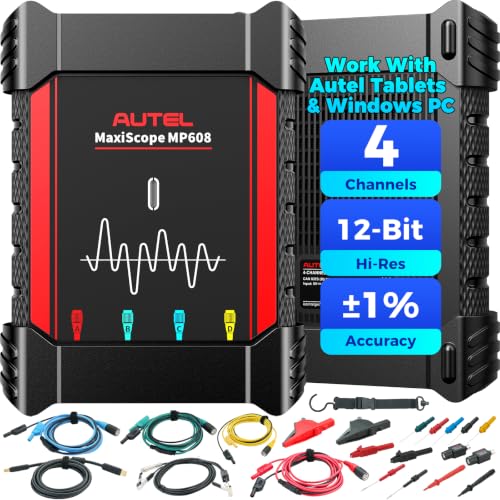
- 12-bit resolution with ±1% measurement accuracy
- AI-assisted formulas, probe parameters, and case library
- Cloud sync, notes, tags, and multi-view analysis modes
Best For: Autel and Windows users who need connected diagnostic workflows
Launch X-431 Scopebox
4-Channel Automotive Diagnostic Add-On

- 4 channels, 100 MHz bandwidth
- Compatible with supported LAUNCH X-431 tools
- Includes vehicle-test probes and clips
Best For: X-431 owners who need a portable add-on scope for automotive diagnostics
Micsig ATO1004
Tablet-Style 4-Channel Automotive Oscilloscope
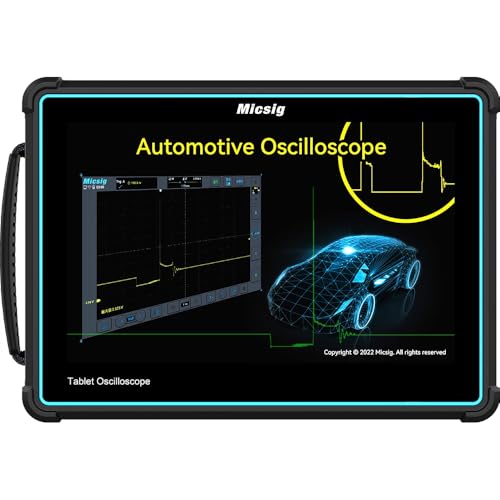
- 10.1-inch touchscreen with 4 channels
- 100 MHz bandwidth, 1 GSa/s, 110 Mpts memory
- Supports ignition, network, charging, and pressure tests
Best For: Portable diagnostic work where touchscreen control and deep memory matter
RIGOL DHO1204
4-Channel High-Resolution Bench Oscilloscope

- 200 MHz bandwidth with 4 channels
- 12-bit resolution and 50 Mpts memory
- Decodes CAN, LIN, I2C, SPI, and UART
Best For: Mixed automotive and electronics users who want a high-resolution bench scope
Android Tablet Scope

- 4 channels, 200MHz bandwidth, 1GSa/s
- 50Mpts memory with zoom for longer captures
- Android-only virtual scope with 7500mAh battery
Best For: Android-based field diagnostics with long battery life
Win-Based Auto Scope

- 4 channels, 250MHz bandwidth, 1GSa/s
- Windows support with USB 2.0 plug-and-play
- 20+ measurements plus PASS/FAIL check
Best For: Windows-based automotive diagnostics and portable use
Bench-Style 4-Channel Scope

- 4 channels, 100MHz bandwidth, 1GSa/s
- 24Mpts memory with 30,000 wfms/s capture
- 16 digital channels with optional MSO upgrade
Best For: Lab users who want expandable digital and analog testing
Portable Android Tablet Scope – Micsig SATO1004 4-Channel Automotive Scope
If you want a four channel automotive oscilloscope that feels more like a modern tablet than a bench tool, the Micsig SATO1004 is built for that workflow. It combines Android-based operation, a physical button panel, and automotive-focused software with 100MHz bandwidth, 1GSa/s sampling, and an 8-inch touchscreen for field diagnostics.
Best For: Technicians who want a portable, tablet-style scope for broad automotive testing and remote viewing.
Pros:
- Android system with optimized automotive diagnostic software and physical buttons
- 4 channels, 100MHz bandwidth, and 1GSa/s sampling rate
- Supports ignition, sensors, actuators, CAN/LIN/FlexRay/K communication, and pressure tests
- 32GB internal storage for waveforms, screenshots, and recorded videos
Cons:
- Remote operation depends on a network environment and stable Wi-Fi
- 7.5V minimum operating voltage may be a consideration for power planning
Overall, the SATO1004 stands out as a flexible diagnostic platform with strong storage and connectivity options. It is a practical pick when you want a handheld four channel automotive oscilloscope that can handle common vehicle testing tasks without feeling tied to a traditional bench setup.
Advanced Diagnostic Add-On – TOPDON Phoenix Scope 4-Channel
The TOPDON Phoenix Scope is aimed at technicians who want a four channel automotive oscilloscope with deeper analysis tools and fast waveform handling. It is designed to work with Phoenix diagnostic tools rather than as a standalone unit, and it focuses on quick capture, replay, zooming, and measurement workflows for vehicle electronics and wiring checks.
Best For: Phoenix tool users who need fast waveform storage, replay, and advanced analysis in a connected diagnostic setup.
Pros:
- 50M memory depth with global and detailed waveform views
- One-tap waveform storage and waveform recording/playback support
- Advanced math functions and FFT analysis for deeper signal inspection
- 23 automatic measurements plus flexible triggering and cursor controls
Cons:
- Works exclusively with compatible Phoenix Max/Smart/Elite/Lite series tools
- Not compatible with Phoenix Nano or XLink
This scope is a strong fit when you already operate inside the Phoenix ecosystem and want faster capture plus analysis features. If your shop values workflow speed and detailed waveform review over standalone use, the Phoenix Scope is well matched to that role.
Large Screen Field Scope – Micsig ATO1004A 4-Channel
The Micsig ATO1004A is a four channel automotive oscilloscope built around a larger 10.1-inch touchscreen and practical storage capacity. With 100MHz bandwidth, 1GSa/s sampling, and support for common automotive diagnostic tests, it is aimed at users who want a spacious display and a familiar tablet-style layout for day-to-day vehicle troubleshooting.
Best For: Technicians who want a larger touchscreen scope for automotive testing and on-device waveform storage.
Pros:
- 10.1-inch touchscreen with 1280 x 800 resolution and 11×10 grid
- 4 channels, 100MHz bandwidth, and 1GSa/s sampling rate
- Up to 110Mpts storage depth for waveforms, pictures, and videos
- Supports ignition, sensors, actuators, networks, charging, starter, CAN/LIN/FlexRay/K, and pressure tests
Cons:
- Battery life is listed as up to 5 hours, depending on model and power use
- Best suited to users who want a touchscreen-first workflow
For technicians who prefer a larger view of their data, the ATO1004A offers a strong balance of screen size, storage, and automotive test coverage. It is a straightforward option when you want a capable four channel automotive oscilloscope with a roomy display for waveform review.
Connected Professional Scope – Autel MaxiScope MP608 4-Channel
The Autel MaxiScope MP608 is a four channel automotive oscilloscope built for connected diagnostic workflows and advanced analysis. It pairs with supported Autel tablets and Windows PCs, and it adds professional features like 12-bit resolution, AI-generated formulas, waveform notes, cloud sync, and multiple visualization modes for more structured troubleshooting.
Best For: Autel and Windows-based users who want a professional scope with analysis, notes, and cloud workflow features.
Pros:
- 12-bit vertical resolution and ±1% measurement accuracy
- AI-generated math formulas, probe parameters, and built-in automotive case library
- Oscilloscope, spectrum, and XY modes with simultaneous multi-view display
- Work-order management, cloud synchronization, and waveform notes/tags
Cons:
- Requires compatible Autel scanners or a Windows 10/11 64-bit PC
- Not a standalone scope for general use outside supported systems
The MP608 is best viewed as a workflow tool for shops that want diagnostics, documentation, and analysis in one package. If you already work inside the Autel ecosystem and want a four channel automotive oscilloscope with stronger software support, this model is easy to justify.
Launch X-431 Scopebox – 4-Channel Automotive Diagnostic Add-On
Launch X-431 Oscilloscope O2-2 Scopebox Analizador | 4 Channels Digital Scopebox Tester USB Port
Check Price On AmazonIf you already use a compatible LAUNCH X-431 scan tool, this four channel automotive oscilloscope add-on gives you a focused way to dig into circuits, sensors, actuators, ignition, and other electrical faults. It’s built as a portable, durable module with 100 MHz bandwidth and a range of automotive test functions for shop diagnostics.
Best For: Technicians who want an X-431-compatible four-channel scope module for deeper vehicle electrical testing.
Pros:
- 4 channels and 100 MHz bandwidth for multi-point automotive waveform capture
- Works with supported LAUNCH X-431 scan tools through the O2-2 application
- Includes practical vehicle-test accessories like probes, clamps, and back-probe pins
- Offers recording, playback, auto-calibration, and waveform math tools
Cons:
- Designed for compatible X-431 devices, so it is not a standalone scope
- 8-bit vertical resolution is less detailed than higher-end bench scopes
For X-431 users, this scopebox adds a solid set of diagnostic tools without overcomplicating the workflow. Its strength is convenience and integration, making it a practical choice for field automotive troubleshooting.
Micsig ATO1004 – Tablet-Style 4-Channel Automotive Oscilloscope
The Micsig ATO1004 is a strong fit if you want a four channel automotive oscilloscope with a tablet-style interface and plenty of screen space for waveform work. It combines 100 MHz bandwidth, 1 GSa/s sampling, and 110 Mpts memory depth with automotive-focused tests for ignition, sensors, actuators, and vehicle networks.
Best For: Techs who want a portable touchscreen scope with deep memory and broad automotive test coverage.
Pros:
- 10.1-inch touchscreen makes waveform review and touch control straightforward
- 4 channels, 100 MHz bandwidth, and 1 GSa/s sampling for multi-signal capture
- 110 Mpts memory depth plus segmented recording and screenshot/video capture
- Supports ignition, CAN, LIN, FlexRay, charging, starter, and pressure tests
Cons:
- At 8.1 pounds, it is not the lightest handheld option
- Battery runtime is listed at up to 5 hours, depending on usage
This model is appealing if you want modern touchscreen convenience without giving up diagnostic depth. Its universal BNC interface also helps keep accessory compatibility broad and costs more manageable.
RIGOL DHO1204 – 4-Channel High-Resolution Bench Oscilloscope
The RIGOL DHO1204 is a bench oscilloscope that suits automotive users who also work on electronics, embedded systems, or network decoding. While it is not automotive-specific, its four channels, 200 MHz bandwidth, and 12-bit resolution make it capable for detailed waveform analysis across multiple signals.
Best For: Users who need a precision 4-channel scope for mixed automotive and electronics diagnostics.
Pros:
- 200 MHz bandwidth and 4 channels for simultaneous multi-signal capture
- 12-bit resolution with 50 Mpts memory for finer detail and longer captures
- Built-in decoding for CAN, LIN, I2C, SPI, and RS232/UART
- 10.1-inch multi-touch display with USB3.0 and LAN connectivity
Cons:
- More of a bench instrument than a dedicated automotive diagnostic tool
- Not packaged with automotive test emphasis like ignition or sensor kits
If your workflow includes vehicle communication buses plus general electronics troubleshooting, this RIGOL model offers strong measurement depth. It’s best viewed as a precision lab-style option rather than a purpose-built scan-tool companion.
Android Tablet Scope – Micsig VTO2004 4-Channel
If you’re comparing four channel automotive oscilloscopes for mobile diagnostics, the Micsig VTO2004 stands out for its Android-only tablet-style workflow, 200MHz bandwidth, and 1GSa/s real-time sampling rate. It is a virtual oscilloscope, so it needs a separate Android phone or tablet with OTG support to operate, but that setup can be appealing if you want a compact, split-type portable tool with deep memory for longer captures.
Best For: Android users who want a portable 4-channel automotive oscilloscope with deep memory and all-day field use.
Pros:
- 4 analogue channels with 200MHz bandwidth and 1GSa/s sampling
- 50Mpts memory depth for extended signal capture and zooming
- Built-in 7500mAh battery rated for up to 24 hours of field testing
- Works with Android devices via USB-C and has a friendly UI
Cons:
- Android only; not compatible with iPhone, iPad, Windows, or Mac systems
- Requires a separate Android device with OTG support to run
- Bulkier than a simple standalone scope because it uses a split-type setup
The VTO2004 makes sense if your diagnostic workflow is already centered on Android hardware and you value long battery life plus deep storage. Just make sure the compatibility fit is right before buying, since the platform limits are strict.
Win-Based Auto Scope – Hantek 6254BE 250MHz
The Hantek 6254BE is a practical pick among four channel automotive oscilloscopes if you want higher bandwidth and a straightforward USB-connected setup. It offers 4 channels, 250MHz bandwidth, and 1GSa/s real-time sampling, plus it is designed for portable computers and tablets running Windows, making it a flexible option for workshop or mobile use.
Best For: Windows users who want a portable 4-channel automotive oscilloscope with strong bandwidth and useful measurement tools.
Pros:
- 4 channels with 250MHz bandwidth and 1GSa/s sampling
- Supports Windows 11/10/8/7 on portable computers and tablets
- More than 20 automatic measurement functions and PASS/FAIL check
- USB 2.0 plug-and-play design with no extra power supply needed
Cons:
- Requires a Windows system, so it is not a universal cross-platform choice
- Sold as a professional instrument, so it may be more than casual users need
- No standalone screen or battery details are listed in the supplied notes
For drivers and technicians who want a computer-based automotive scope with plenty of bandwidth, the 6254BE is a strong fit. Its measurement and trigger features add practical value for day-to-day troubleshooting.
Bench-Style 4-Channel Scope – Rigol DS1104Z Plus 100MHz
Among four channel automotive oscilloscopes, the Rigol DS1104Z Plus is a solid bench-style choice for users who want a classic 4-channel digital scope with deeper memory and digital expansion potential. It provides 100MHz bandwidth, 1GSa/s sampling, and 24Mpts memory, along with 16 digital channels and an optional MSO upgrade path.
Best For: Buyers who want a 4-channel digital oscilloscope with logic-channel expandability and deeper memory.
Pros:
- 4 channels with 100MHz bandwidth and 1GSa/s sampling
- 24Mpts memory depth for deeper waveform storage
- 16 digital channels and optional MSO upgrade support
- High waveform capture rate up to 30,000 wfms/s
Cons:
- Lower bandwidth than some automotive-focused alternatives
- More of a traditional oscilloscope than a dedicated field handheld
- Digital upgrade features may be more than basic users need
The DS1104Z Plus is a good fit when your priority is flexible lab-style testing and expandable channel capability rather than a rugged mobile form factor. It brings a reliable balance of memory depth, capture speed, and future upgrade potential.
How We Picked the Best Four Channel Automotive Oscilloscopes
We focused on Four Channel Automotive Oscilloscopes that balance channel count, sampling speed, bandwidth, memory depth, and workflow features that matter in real diagnostics. We also considered portability, display quality, accessory support, and how well each unit fits common automotive testing tasks such as ignition, crank/cam correlation, injector control, and network troubleshooting.
Quick Comparison
For fast vehicle work, the most useful differences usually come down to usability and signal quality. Portable tablet-style units are easier to move around the bay, while bench-style scopes often offer stronger core performance for the money. Higher bandwidth helps preserve waveform detail, but many automotive jobs are better served by a stable interface, enough memory to capture long events, and dependable probe support.
Key Buying Factors for Four Channel Automotive Oscilloscopes
Bandwidth and Sample Rate
Choose bandwidth based on the signals you test most often. For general automotive diagnostics, moderate bandwidth is usually sufficient, but faster sample rates help with sharp edges, noise, and short glitches. If you work on modern ignition or high-speed control signals, extra headroom is worth paying for.
Memory Depth and Triggering
Long memory helps preserve detail during extended captures, especially when faults happen only once in a while. Good trigger controls are just as important, since they make it easier to isolate an event instead of scrolling through a noisy trace.
Portability and Workflow
Shop-friendly Four Channel Automotive Oscilloscopes should be easy to carry, quick to power up, and simple to operate with one hand or on a cart. Tablet-based models can improve visibility and touch navigation, while PC-connected scopes may suit users who prefer a larger workstation setup.
Accessories and Vehicle Compatibility
Probe quality, test leads, clamps, and included adapters affect how quickly you can start testing. Look for kits that support common automotive measurements without forcing immediate add-on purchases.
Who Should Buy Which Four Channel Automotive Oscilloscopes?
Mobile techs and field diagnosticians should prioritize portable, rugged designs with a fast setup. Shop technicians who handle a mix of engine, charging, and network tests may prefer a balanced model with strong display controls and good accessory bundles. Advanced users who want deeper waveform analysis may benefit from higher-bandwidth bench scopes or tablet scopes with more memory and better capture tools. If you mainly troubleshoot occasional vehicle issues, a straightforward four-channel model with dependable basics is often the smartest buy.
In short, the best choice depends on your workflow: portability for on-the-go work, performance for demanding signal analysis, and accessory value for everyday automotive testing.